Pages

Wednesday, June 3, 2026

Can Money Solve Homelessness?


Let’s pretend, for a moment, that you just found out that you were fired from your job because they found a way to replace you with AI; or that you were diagnosed with an illness that requires very expensive medications or a very expensive surgery; or that your landlord has decided to sell the home you’ve been living in for 10 years to new real estate agency who intend on increasing the cost of rent by $500 a month if you’re interested in staying.


The sad truth is that these are very real circumstances that are becoming more & more common, & so I’m going to ask you a very simple question: What do you think would help you most in this situation: $1,000 a month with no strings attached or an expense free shelter where you’ll share your personal space with 20, 30, or 40 other people in similar or worse circumstances? 


I’m assuming, you’d take the $1,000 a month without question. So, if the solution seems so obvious to you, why haven’t we been approaching this strategy to solve homelessness? 


Let’s run some simple numbers: According to OregonLive, $742 million are spent on addressing homelessness in Portland alone (Thomas, 2025). If all of that money were redirected towards simply providing people experiencing homelessness $1,000 a month for a year, you’d be able to provide direct support to 61,333 individuals. Of those 61,333 individuals, 91% of them are likely to find housing within that year (Mongeau, 2025). That’s 56,268 people out of homelessness. 


When compared to the current method of “solving homelessness,” one has to question: What are we doing? 


I’d argue that because we’ve spent so long viewing homelessness as some moral failing, we’ve lost sight of the underlying empathy needed to resolve this social ailment. 


I invite you to present this way of thinking to everyone you know, because some day, it may be you who needs this change. 


Mongeau, Lillian. “Here’s How Much Was Spent on Homeless Services in the Portland Area Last Year.” Oregonlive, 9 July 2025, www.oregonlive.com/politics/2025/07/heres-how-much-was-spent-on-homeless-services-in-the-portland-area-last-year.html


Thomas, J. (2025, November 19). Oregon pilot program giving cash to homeless youths sees staggering reduction in homelessness. Street Roots. https://www.streetroots.org/news-stories/2025/11/19/oregon-experiments-direct-cash-payments-assist-homeless-youths/ 


The Prison Trap


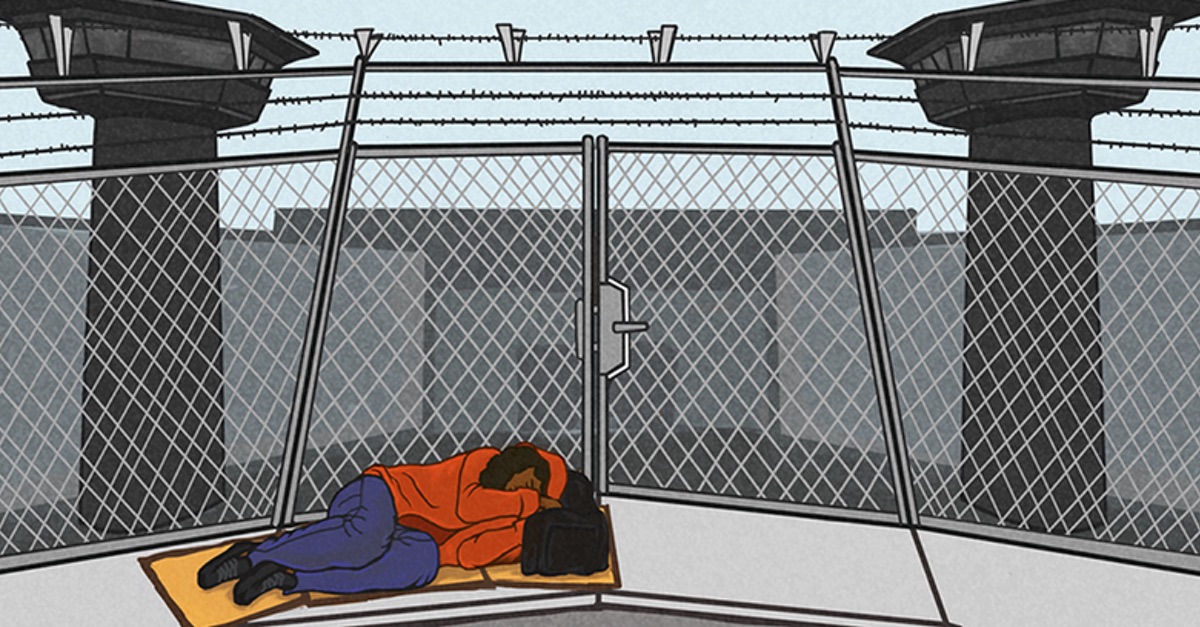
5 in 6 people who were released from prison were arrested again within the first 9 years after being released (Alper, 2018) 15.3% of prisoners had experienced homelessness in the year leading up to their arrest (Greenberg, 2008). Though these issues seem unrelated, there are overlapping contributors to people experiencing houselessness. We are all driven by basic needs that we must fulfill: food, water, & a reliable place to rest safely. When people are put in situations where these needs become more difficult to meet, they will find some way to cope: sex, substances, mental escape. They may also turn towards alternative methods of meeting those needs: harmful romantic/sexual relationships that provide safety, theft, or other forms of crime. 

A new economic landscape is emerging, in which the average person is unable to meaningfully meet their basic needs. This has caused a spike in crimes, such as the warehouse fire attributed to a disgruntled employee that stated, “If you’re not going to pay us enough to f*cking live, at least pay us enough not to do this.” (ABC7 Chicago, 2026) This economic dismay is the same underlying motive behind people committing petty crimes, such as car break-ins or other forms of theft. By removing honest paths towards fulfilling the basic needs of oneself or loved ones, crime will become a growing norm. 


Unfortunately, this results in a feedback loop. The more often you’re incarcerated, the less likely that you’d be housed. With the average American one paycheck away from houselessness, this is a frightening infrastructure that is built on false moral grounds. Why punish people for trying to meet their basic needs? The entire purpose of the government is to assure the mutual benefit to all those participating in that system. 


So, then, what do we do? 


Let’s be honest about our current situation & work together, both within & outside of government systems. Within, let’s elect representatives that have plans to address these real contributors of economic anxiety: AI regulations, food accessibility, employee protection, & fair housing policies. Outside of the system, let’s work together to find ways to address our needs: community gardens, co-op housing options, lending circles, & other forms of communal aid programs. 


ABC7 Chicago. New video appears to show start of Southern California warehouse fire, may reveal motive. (2026, April 9). ABC7 Chicago. https://abc7chicago.com/post/new-video-toilet-paper-being-set-fire-reviewed-part-investigation-southern-california-warehouse/18860399/ 


Alper, Mariel, et al. Special Report 2018 Update on Prisoner Recidivism: A 9-Year Follow-up Period (2005-2014). U.S. Department of Justice, May 2018, bjs.ojp.gov/content/pub/pdf/18upr9yfup0514.pdf.


(IMAGE SOURCE) Couloute , L. (2018, August). Nowhere to Go: Homelessness among formerly incarcerated people. Prison Policy Initiative. https://www.prisonpolicy.org/reports/housing.html 


Greenberg, Greg A., and Robert A. Rosenheck. “Jail Incarceration, Homelessness, and Mental Health: A National Study.” Psychiatric Services, vol. 59, no. 2, Feb. 2008, pp. 170–77, https://doi.org/10.1176/ps.2008.59.2.170


Tuesday, June 2, 2026

It’s Time to Clear Away Spending on Sweeps

The experience of being homeless is not pretty nor dignified. Those who must endure it firsthand are often relegated to out-of-sight, out-of-mind because of how much of a source of discomfort their situation is to others. On the other hand, for those living near homeless encampments, I can imagine how jarring it must be to be confronted daily with the realities of how some people live in order to survive. 


I understand not wanting to have strangers sleep on your sidewalk, or do drugs in front of your children as they walk to school. 


But moving the problem around the corner is not the same as solving it. 


When it feels like nothing is being done, any visible change can seem like a step in the right direction. This is where I believe the impetus for homeless encampment sweeps comes from, a desire to do something, anything that seems to help. But the illusion of progress never helped anyone in the long run.  


Portland spent $72.5 million in 2025 on sweeps and emergency shelter funding. Between 2021 and 2023, Portland spent $200,000 per homeless individual. Yet homelessness continues to rise in Oregon, and the death rate of homeless people in Portland has quadrupled from 2019 to 2023. 


Many people lose what precious stability they have when the sweeps come through. Their belongings are thrown away, and they must move somewhere new despite any connections to community or services they may have previously had access to. One Portland individual named Debby Beaver was 57 when she died a week after a sweep due to her medication being thrown out. The city contractors responsible for the sweep, without admitting any wrongdoing, paid a settlement of $45,000 after her family filed a wrongful death suit. Sisters of the Road and the Welcome Home Coalition, an advocacy group, released a report which found that people experiencing homelessness saw living in shelters “as undesirable as outdoor spaces.” The same report found that housing affordability was the biggest cause of homelessness and the biggest barrier to getting out of it. Pushing people who have nowhere else to go into temporary shelters that feel unsafe as their only option is cruel and unhelpful.  


The punishment of sweeps is not helping anyone.


If there is kind of money to pay for sweeps and shelters, then those resources should be allocated towards a solution that will actually improve all our lives: affordable permanent housing. Everyone deserves a safe and stable home. The way to ensure that for all citizens and residents is to increase access, not shove those who are in a rough way down the road. 


To read more about sweeps and what is actually happening in homeless communities, click the links below. 


Portland’s top leader escalates homeless sweeps amid federal crackdown - Street Roots


Portland said it was investing in homeless people’s safety. Deaths have skyrocketed. - Street Roots


Officials say the 'camping ban' is meant to offer resources to homeless Portlanders. None of them are tracking whether it’s working. - Street Roots

Monday, June 1, 2026

You Can't Win Without a Paper Trail


If you are living on the streets, your most valuable possessions are not your clothes or your sleeping bag. They are your ID, your birth certificate, and your Social Security card. Lose those and you lose everything else. No shelter. No job. No benefits. You stop existing on paper.

To replace any of those documents you need an email address and a phone number. Things that are a lot harder to have when you do not have a home. It is a circle with no way in. Cities everywhere are trying to figure this out. Nobody has it perfect. But some places are building something real.

First you have to actually get the documents. In Arizona the Homeless ID Project works five days a week doing exactly that. They help people replace lost IDs and birth certificates, processing over 57 documents every single day, and they partner with 61 organizations across the state whose doors only open if you can prove who you are. One ID. Sixty one doors that were closed before.

Then you have to keep them. In Pueblo, Colorado, the County Clerk launched the Kayleigh Morgan Project, built by a former homeless advocate who now runs the office. The idea is simple. Take a digital snapshot of your birth certificate, your ID, your Social Security card, and hold onto it for you. Lose your backpack, get swept from a camp, flee a bad situation. Your documents are still there waiting.

Then you have to be able to use them. In New York City a council member introduced legislation last year requiring free reliable Wi-Fi in every homeless shelter in the city. Because what good is having your documents if you have no way to email them, apply online, or contact a caseworker. The internet is not a luxury anymore. It is the door that opens all the other doors.

Get it. Keep it. Use it. Three steps. Three cities working on three pieces of the same problem.

Portland has good people working on pieces of this already. Blanchet House runs street outreach that specifically helps people get their IDs and birth certificates back. But nobody has connected the dots yet into something bigger. These cities are showing it does not take a massive budget or a perfect plan. It just takes someone deciding it is worth solving and then actually showing up to do it.

That someone could be you.

Learn more about what Pueblo is doing with the Kayleigh Morgan Project and why safe document storage could be a game changer for people trying to rebuild their lives.

And if you want to support the work happening right here in Portland, Blanchet House’s Old Town InReach Program is doing exactly this kind of work every day. They could use your help.

For Those Who Are Homeless, Access to Storage Can be a Matter of Life or Death.


An exterior view of the City day storage location
City Storage Day Program by: Central City Concern. Portland OR 


Imagine if all you had in the world you had to carry with you? Not only that, imagine day and night, you couldn’t  have those belongings safely out of your sight or away from your body at risk of them getting taken? Everywhere you go, whether outdoors, indoors, or on public transportation they are with you. Some of these items, especially bags or sleeping bags, may be cumbersome or dirty from dragging them around the city. It’s hard to be discreet, or not in the way and if you have important errands to run, the stress compounds as people may treat you as a nuisance or unwelcome. Any important documents, mementos or lifelines like a cellphone and components are especially at risk of theft or damage by the elements. If you hide your belongings or leave them out in the city, whether a tent, a suitcase or basket to store more things and keep weight off your back, anything really, they could be “swept” away by the city. The same goes for a bike or wagon or trailer. Although items are kept for 30 days, there is only a 4% retrieval rate (Harrop, K, et al., 2024).

My shoulders hurt just thinking of it! I don’t even like the weight of bringing a reusable water bottle or a lunch bag with me to work every day. When hiking or backpacking, people learn that even ounces make a difference, and there is a whole industry around light, travel friendly gear, that is often pricey. Some of us know the feeling of traveling to and from an airport, but killing time on the way in a business, perhaps a gift shop or bookstore, how hard it is to browse with the weight of our packs and suitcases. Many people might make it a shorter trip if there wasn’t a bag check! You get the picture.

If you are homeless in Portland, OR, there are a few options to store one’s belongings. Ground Score run by the Homeless Services Dept, offers storage from 8am-4:30 pm, with coffee served from 8-9:30 am, and free snacks and healthy drinks available while open. Their max storage is 3 plastic bins, with some large item storage depending on availability.  Another option is the City Storage Day Program operated by Central City Concern. They are open 7 days a week, 7am-7:45 pm. Their storage limit is a 30-gallon drum with a closed lid. Weapons, food and liquids are prohibited. Their storage limit is 30 days.

It’s a start, but with homeless numbers being what they are (about 12,000 individuals at last count), there is a need (University Communications, 2025). Since the increase in sweeps, there has been a fourfold increase in deaths among the homeless population (Rambo, 2025). With the loss of critical belongings and their not so easy replacement, access to storage for the homeless can be a matter of life and death.

References:

Harrop, K., Chakrabarti, M. & Skoog, T. (2024, December 12). Inside America’s homeless sweeps. Wbur. https://www.wbur.org/onpoint/2024/12/12/homeless-encampment-sweeps-portland-propublica

Hayden, J. (2025, August 20). Portland’s top leader escalates homeless sweeps amid federal crackdown. Street Roots. https://www.streetroots.org/news-stories/2025/08/20/portland-top-local-federal-leaders-escalate-homeless-sweeps-public-spaces/

Rambo, K. (2025). Portland said it was investing in homeless people’s safety. Deaths have skyrocketed. Street Roots. https://www.streetroots.org/news-stories/2025/06/11/portland-homeless-deaths-multnomah-county/

University Communications (2025). PSU  homelessness research and action collaborative releases the 2025 point in time count. Portland State University. https://www.pdx.edu/news/psu-homelessness-research-and-action-collaborative-releases-2025-tri-county-point-time-count