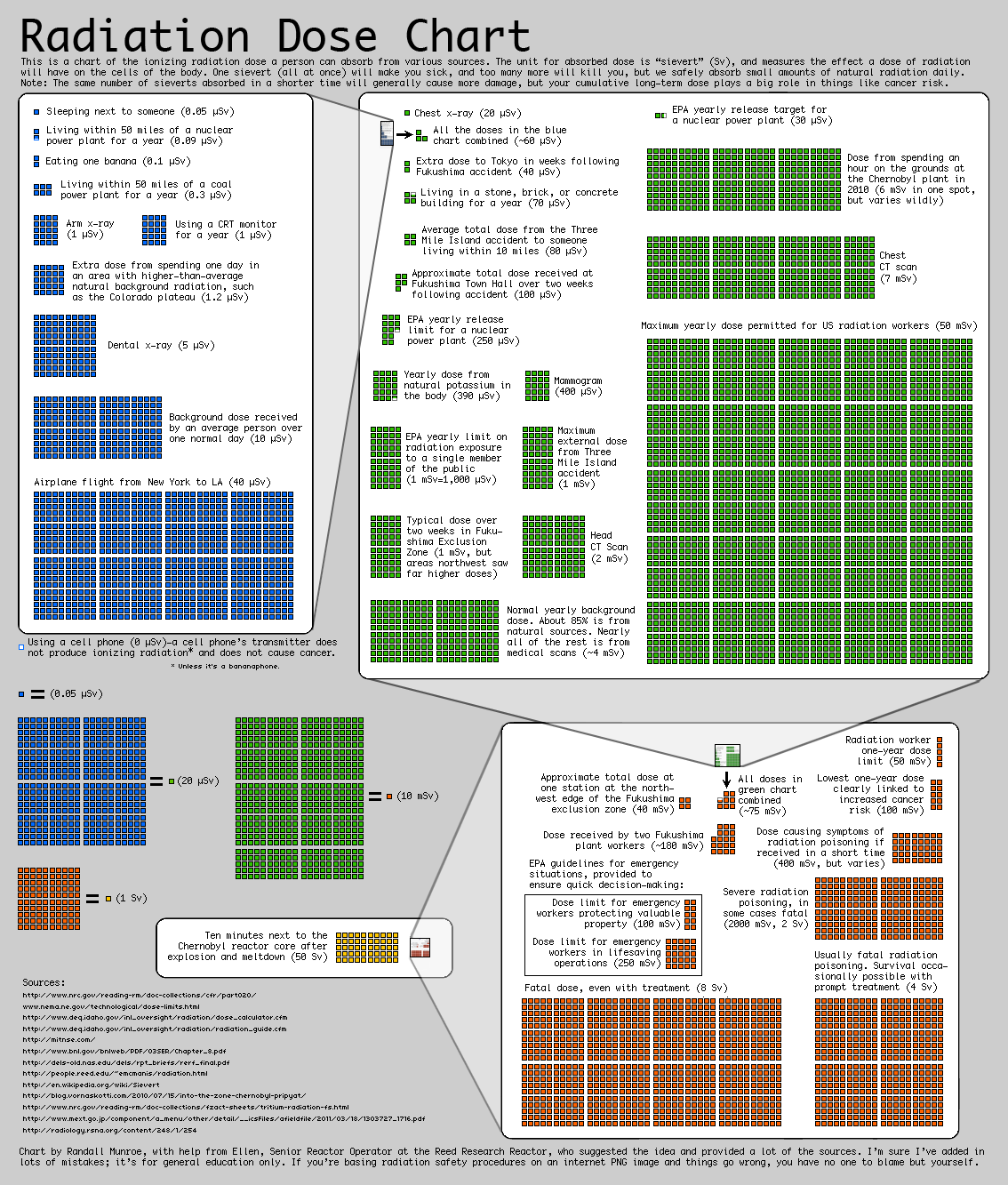
It's incredibly hard to ignore Japan when talking about nuclear power due to the recent disaster. Though the above chart (and link) was assembled by someone who is not an expert on radiation, I believe that he has illustrated this issue in a very accessible fashion. We are exposed to radiation every day, and though what happened in Japan was a tragedy in many ways, it's important to keep the nuclear aspect of the events in perspective. If you click the link in order to see this image at full size, you will be able to view the sources used to create it. For the brave (or less easily bored) I recommend looking at this chart (which was linked to by xkcd as well) for a more detailed (and less colorful) portrayal of this issue.
Welcome to EcoLife! This blog, which is hosted by Portland State University students, aims to motivate, inform, and inspire change. We want you to learn about the complicated issues surrounding homelessness, while going beyond the tip of the iceberg. We hope to establish a connection with you through our posts regarding the lives and experiences of homeless individuals, expressed in these numerous stories and articles. We hope you enjoy our blog!
Monday, May 9, 2011
Japan's Radiation In Perspective
It's incredibly hard to ignore Japan when talking about nuclear power due to the recent disaster. Though the above chart (and link) was assembled by someone who is not an expert on radiation, I believe that he has illustrated this issue in a very accessible fashion. We are exposed to radiation every day, and though what happened in Japan was a tragedy in many ways, it's important to keep the nuclear aspect of the events in perspective. If you click the link in order to see this image at full size, you will be able to view the sources used to create it. For the brave (or less easily bored) I recommend looking at this chart (which was linked to by xkcd as well) for a more detailed (and less colorful) portrayal of this issue.
Coal Ash is More Radioactive than Nuclear Waste

This article shocked me to see that nuclear waste is actually less harmful to a human being then coal ash. I understand that neither is a substance we should deal with but to see the effects of coal ash in comparison to nuclear waste makes me shocked to see how coal production and mining has not even attempted to slow; even with the advances in other energy sources(nuclear, wind, solar, etc.). There is such a drastic difference in radioactivity that coal plants emissions are 100x more radioactive than nuclear waste. Follow the link below for more of this shocking information:
Image and Information brought to you by:
http://www.scientificamerican.com/article.cfm?id=coal-ash-is-more-radioactive-than-nuclear-waste
Whatever Nuclear Power's Threat, No Easy Alternatives
The discussion on alternatives to nuclear power after the power plant disasters in Japan has brought up 2 very interesting arguments. First, we need to change from nuclear power immediately due to the risks of something like the disaster in Japan happening again, or worse. This argument is very valid because of the idea of if something big goes wrong in a nuclear plant then more then just a few people are harm unlike coal mines. The other argument though shows the side that would like an alternative to nuclear power but does not feel like we have it yet. It argues that through the history of nuclear power, more deaths have happened from coal mines and oil drilling then in nuclear plant disasters. I feel that it is our job as a society to look at both of these sides to find out truly what is safer for us, Coal, Oil, Nuclear, None?
Information was found at:
http://www.nytimes.com/2011/03/21/business/energy-environment/21green.html
Information was found at:
http://www.nytimes.com/2011/03/21/business/energy-environment/21green.html
Saturday, May 7, 2011
Basics of Nuclear Fission
When I think about a power plant I usually think of the end result. I wouldn't even know how to begin to describe what the process actually entails. So, I thought it might be interesting for others as well who are a bit clueless on what nuclear fission actually is. The web site attached below has many topics ranging from the description of single atoms to the basics of nuclear fission and how reactions work. I found it to be most interesting and informative. When trying to improve or change a current habit or action it is best to completely understand what your trying to change in the first place. How can you solve or improve a problem if you don't understand how it works.
One section which I thought was very interesting was called New Nuclear Power Tecnologies. It lists two different approaches to nuclear power. One was reprocessing, which turns out to be a double edge sword. Basically through another reaction we can reuse some parts of the nuclear waste which you would think would be good but the reprocessed fuel is even more dangerous and actually easier to use in the creation of a nuclear weapon. The second approach is called high temperature breeder reactors. This creates a non-weapon grade fuel which can not be used to make bombs. It said this type of recator was currently being developed and could possible be the furture of nuclear power.
Well, the site definitely provides a good first step at understanding the inter-workings of what nuclear power is for anyone wanting to understand that process. Like I said earlier as well it has many different section all with very relevant and interesting information.
http://library.thinkquest.org/17940/texts/fission/fission.html
One section which I thought was very interesting was called New Nuclear Power Tecnologies. It lists two different approaches to nuclear power. One was reprocessing, which turns out to be a double edge sword. Basically through another reaction we can reuse some parts of the nuclear waste which you would think would be good but the reprocessed fuel is even more dangerous and actually easier to use in the creation of a nuclear weapon. The second approach is called high temperature breeder reactors. This creates a non-weapon grade fuel which can not be used to make bombs. It said this type of recator was currently being developed and could possible be the furture of nuclear power.
Well, the site definitely provides a good first step at understanding the inter-workings of what nuclear power is for anyone wanting to understand that process. Like I said earlier as well it has many different section all with very relevant and interesting information.
http://library.thinkquest.org/17940/texts/fission/fission.html
Thursday, May 5, 2011
While Nuclear Waste Piles Up in U.S., Billions in Fund to Handle It Sit Unused
![]() |
| The Yucca Mountain site |
With the nuclear predicament in Japan shedding light on how fragile nuclear power plants actually are, the spotlight has shifted to the spent fuel rods piling up in the US. What a lot of people don’t know is that there is 24 billion dollars just sitting in a nuclear waste fund for this purpose, but without a safer way to store waste it can’t be used. This money comes from taxes charged to nuclear reactor operators. In turn, the government would use the money to create a safe place and way to store reactor waste. The original plan was to store it inside the volcanic rock of Yucca Mountain which about 100 miles northwest of Las Vegas. 29 years later, the project was scrapped by the Obama administration. Nuclear companies have had to take the rods out of their own crowded pools and encase them in steel or concrete, a job that the government should have been doing all along. These dry casks are considered to be a safer way to store the rods. It’s extremely expensive to move pooled rods to dry casks. One expert estimates that it would cost 3.5 billion dollars to transport all of the spent rods that have been in pools for over five years. Because of this, companies have filed a multitude of lawsuits equaling about 6.4 billion dollars. The government has already paid out around 956 million dollars to these companies. Everyone loses with what’s happening; the only ones getting rich are the layers. Nuclear power has been around for the better part of a century and no one has come up with an effective way of dealing with the spent rods. It’s time to say enough is enough at to dedicate our time and money into other ways of getting energy besides nuclear power. For further reading check out http://www.propublica.org/article/while-nuclear-waste-piles-up-in-u.s.-billions-in-fund-to-handle-it-sits-unu
-John Curran
Wednesday, May 4, 2011
Nuclear Waste... Who wants it?
For the past thirty years lawmakers on capital hill have been fighting over the placement of our country's nuclear waste. Nuclear energy provides 20 percent of our country's energy but what happens to the waste? Thirty years ago a law was passed to place it here at Yucca Mountain in Nevada. Construction has stopped and started several times throughout the years as new administrations have different views about the impact of radioactive waste being placed in the ground. This kind of situation isn't new to citizens in Las Vegas where forty years ago radioactive bombs were tested in the desert just outside the city limits. Follow the link below for more...
Continue reading about Yucca Mountain
http://www.lasvegassun.com/news/2011/may/04/gop-launches-probe-allegations-over-yucca-mountain/
- Adam Smith
$496,000 in state grants to propel wave-energy projects closer to Oregon’s ocean.
Aquamarine Power, a firm located in Scotland, UK, has found its home in Newport, Oregon. A combination of state grants totalling $496,000 has led to the testing and developing of wave-energy projects in Oregon’s ocean. This new product by Aquamarine Power is known as the Oyster and can generate 100 megawatts of power.
The zoning of the ocean is part of the many issues with moving forward on the current project of testing the Oyster on the Oregon coast. Right now, to test the Oyster, it will require a lease to Aquamarine Power for 7,000 acres of ocean just off the Oregon Coast. Zoning this amount of ocean space will take several coordination efforts to move the project further. Until, the state makes a decision there is need of community support to help the project move forward.
Read more: http://www.oregonbusiness.com/articles/99-may-2011/5162-waiting-for-wave-energy?start=2
Subscribe to:
Posts (Atom)