Pages

Saturday, June 7, 2025

Family Homelessness on the Rise Again

 A group of people standing in a line

AI-generated content may be incorrect.

Before Covid, family homelessness had been trending downward since 2012, which had previously been at record highs due to the 2008 economic crisis. Leading up to this decreasing trend were dozens of articles and research studies, intent on examining and informing on the issue, seeking to spread awareness and discuss possible methods of change.

Now, in the past few years, the 2012 downward trend in homeless families has stopped, and even been reversed, once again connected to a period of economic crisis, most notably from the wave of Covid evictions. And while the general rise in homelessness has been examined closely, there has rarely been a focus on homeless families, despite the reality that, among the demographics examined among homelessness, homeless families with children have had an extreme rise, 16% between 2022 and 2023, and a staggering 39% between 2023 and 2024. In 2023, homeless families accounted for 186,084 individuals, approximately a third of the total homeless population.

In part because many families experiencing homelessness seek to avoid being completely unsheltered, it’s a demographic that can often go overlooked. Rather than the homeless we pass on the street, the familial form of homelessness tends to take advantage of temporary shelter, either from organizations, or from friends and family. While this is undoubtedly silver lining, the issue remains that the rise in homeless families is a significant problem, and one that seems to have had little focus from studies and articles in recent years. Most recent articles that do mention homeless families do so only as a part of examining the wider homeless demographics.

We mustn’t forget that that even sheltered homelessness is still an issue, even if it is a better result than being on the street.

For more information:

Homelessness in America: Statistics, Analysis, and Trends

https://www.security.org/resources/homeless-statistics/

Fact Sheet: 2023 Annual Homelessness Assessment Report Key Findings from the Point-in-Time Counts

https://www.hud.gov/sites/dfiles/PA/documents/Fact_Sheet_Summarized_Findings.pdf

HUD Releases 2024 Annual Homeless Assessment Report

https://nlihc.org/resource/hud-releases-2024-annual-homeless-assessment-report

When Home Isn’t Safe: The Overlooked Link Between Domestic Violence and Homelessness

by Manal Alkindi, Jun 7 2025 


When I used to think about homelessness, I pictured tents on sidewalks, sleeping bags under bridges, or people asking for change at intersections. I never really thought about how someone could become homeless just by trying to save their own life. That changed when I learned more about the connection between domestic violence and homelessness, and how often people—especially women and children—become unhoused not because they are poor or lazy, but because they are trying to escape abuse.

It's a reality that’s deeply underrecognized: domestic violence is one of the leading causes of homelessness for women. According to the National Network to End Domestic Violence (NNEDV), 57% of homeless women report domestic violence as the immediate cause of their homelessness [1]. That number is staggering—and heartbreaking.

Leaving Isn’t Easy

It’s easy to ask, “Why didn’t they just leave?” But the truth is, leaving can be one of the most dangerous and difficult decisions a survivor ever makes. Abusers often control every part of their victim’s life—money, transportation, phone access, and even relationships with friends and family. Leaving often means starting from zero, with no income, no safe place to go, and children to protect.

Many survivors leave their homes and end up sleeping in their cars, staying at emergency shelters, or bouncing between friends’ couches. Some shelters only offer short-term stays, and transitional housing programs can have long waitlists or strict entry requirements.

A 2023 report by the U.S. Department of Housing and Urban Development (HUD) found that over 38,000 people in a single night were experiencing homelessness as survivors of domestic violence [2]. These aren’t just statistics—they’re people who made the hardest choice to walk away, only to find the system wasn’t ready to catch them.

We Need to Do Better

What hurts most is knowing that so much of this could be prevented. Survivors need more than just a shelter bed—they need stability, trauma-informed care, and affordable long-term housing. Programs like Housing First, which provide housing without preconditions, have been shown to improve outcomes for survivors by giving them a foundation to rebuild safely [3].

There’s also the emotional toll. Many survivors carry deep trauma, guilt, and fear—not just from the abuse itself, but from the judgment they receive after leaving. Society often blames survivors for not leaving sooner, without acknowledging how broken and dangerous the system is once they do.

  1. National Network to End Domestic Violence. “Domestic Violence & Homelessness”

  2. U.S. Department of Housing and Urban Development. 2023 Annual Homeless Assessment Report (Part 1)

  3. National Alliance to End Homelessness. “Ending Homelessness for Survivors of Domestic Violence”

Indigenous Led Housing Solutions for Indigenous People in PDX!

By Miguel S. Chanocua Jun 7, 2025


As someone who is  both a resident of Oregon and an Indigenous Oregonian homelessness is something that is very personal and close to me. When I was very young my family and I became homeless and actually lived in our car for about 6 months or so. That was a very hard time in my life that my family and I will never forget during a time when there weren't very many resources at all for people experiencing homelessness. 


The reason for divulging a bit of my personal history to you all is because, in our beautiful city of Portland Indigenous people are still experiencing homelessness at a very high rate. However,  even now when there is so much hopelessness, Indigenous people and communities here in Portland have found ways to create solutions that bring New Hope and perhaps some healing to Indigenous people experiencing homelessness in Portland, and I want to share with you just one of the ways that Indigenous organizations and communities are leading the way to create housing and help for Indigenous people in Portland.


Nesika Illahee “Our Place” 

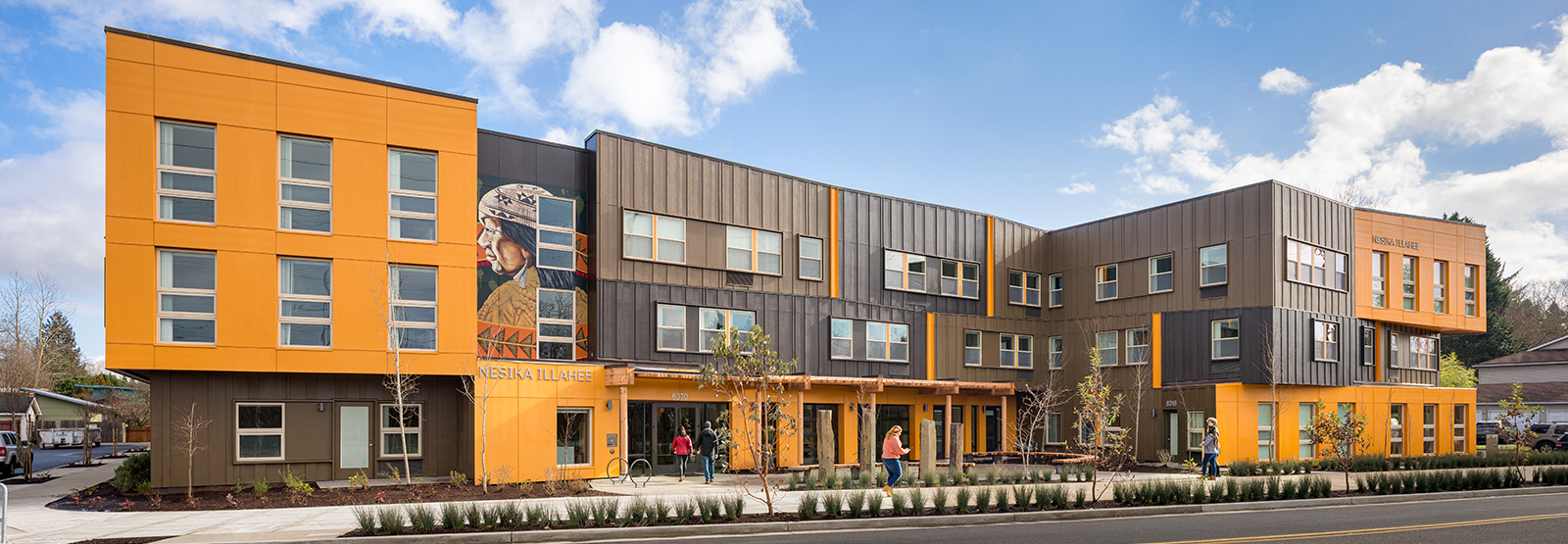
Photo of Nesika Illahee from NAYA

Nesika Illahee is Chinook language, my language, and means “Our Place”. The building is a 59 unit apartment complex built for Indigenous people here in Portland. The Confederated Tribes of the Siletz Indians. In addition to that the project was federally funded which was a big deal because federal money was never used for something like this in a big city. Saying that this place is just a living space for people would be a huge understatement. It is way more than that. There is indigenous artwork and murals throughout the building inside and out and spaces for people to gather and connect with their culture and traditions. Nesika Illahee also partners residents with help from NARA as well on their journeys to rehabilitation which provides support for them to stay strong in health and spirit. Nesika Illahee is just one of five housing projects that were specifically built to help out Portland’s Indigenous population with housing and other supports. 

But why is this important work?

When I think about why this type of work is important I am always taken back to my childhood, sleeping in that cold Pinto wagon and scared about what would happen to us and if that was just going to be the way things were going to stay. No one should have to go through that to live like that. 

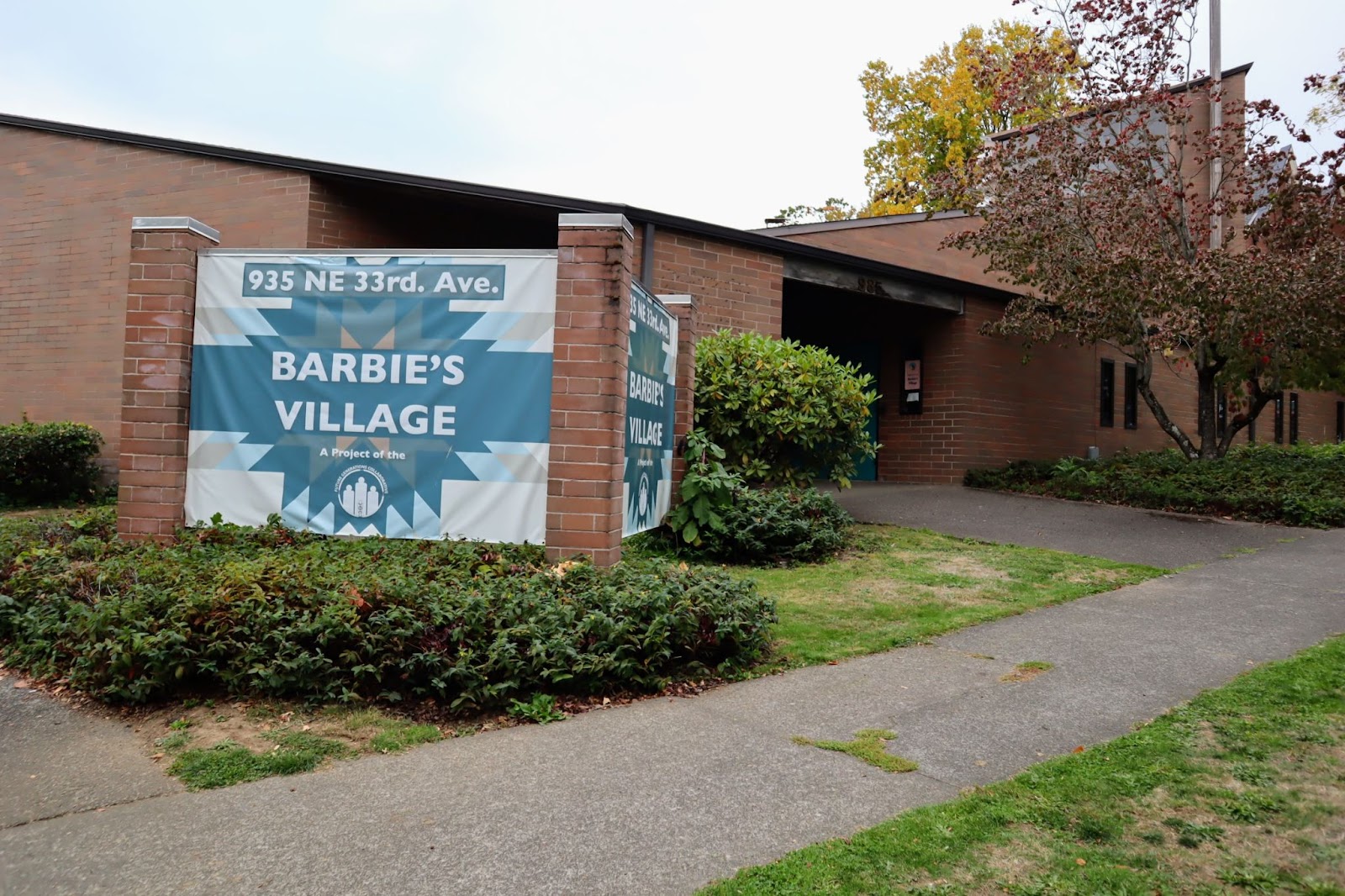
That is why projects like this, especially ones that are Indigenous led projects like Nesika Illahee allow us to see what can change when people and communities come together to enact real change for people. Projects like this give more than just housing, they give people back their culture, dignity, and sense of community. But there is more that can be done and more organizations are leading the charge like the Future Generations Collaborative(FGC) and their project “Barbie’s Village” which is a tiny home project that is underway to house Indigenous people as well in a space that both honors the many cultures and supports Indigenous individuals and families. 

Picture of Barbie’s Village in NE PDX from The Oregonian 

To Learn more about these projects and the resources they offer visit their websites.

Native American Youth and Family Center (NAYA) or Future Generations Collaborative

Tuesday, June 3, 2025

Seeing Today’s Homelessness Crisis Through Evicted ------------Poverty, Forced Moves, and the Housing‑Profit Machine in 2025 America

 By Tony Tong

1. Why go back to Matthew Desmond's Evicted?

      When sociologist Matthew Desmond immersed himself in Milwaukee between 2008–2010, he discovered a painful driving force behind U.S. poverty: landlords reap oversized gains by leasing the most substandard housing to the lowest-income families and then displacing them through speedy evictions. The book, released in 2016, contended that eviction is both a result and a driver of entrenched poverty—wrecking credit, employment, health, and social connections all at the same time. Nine years subsequent to their presentation, those arguments appear to resemble less an exposé and more a manual designed for comprehending a national emergency.


Monday, June 2, 2025

Portland’s 2025 Strategy: What Does it Mean For Homelessness?

I wrote in April on this blog about Portland Mayor Keith Wilson’s plans for solving the homelessness crisis. Now that the preliminary budget has been released as of May 21st we can begin to predict a path forward for the next year and reflect on the state of the city and what it all means for actionably addressing homelessness. 


Previously, the addition of any resources outside of those already allocated seemed unlikely given the existing deficit and the $28 million price tag of Wilson’s proposal to add 1,500 overnight shelter beds by year's end. Through some unprecedented strategy and cooperation, Portland’s Metro Council and Multnomah County together approved a portion of the funds in spite of facing an historic budget shortfall (1). This move, while not providing a cure-all solution by any means, at least shows that the homelessness crisis is in fact a priority across various elected offices of the state, and provides a precedent for meaningful collaboration moving forward. 


Considering the idea of collaboration and efficiency being important for the future of the homelessness crisis, Keith Wilson’s strategy specifically has an interesting angle. Providing additional shelter space in Portland is not just designed to provide shelter, but to more tangibly offer a less punitive means of enforcing the city’s prohibited camping ordinance (1). It also aligns with a new rule directing the distribution of tents only during severe weather and cold weather advisory events- a rule estimated to save the city around $600,000 (2). These moves separately are small things but together indicate a possible change in direction for the better in terms of a more measured, unified approach at problem-solving.


While helpful in the short term for the aforementioned reasons, providing additional shelter beds is not a substantial enough solution to permanently get people off the streets in Portland or anywhere else. What people need is a path towards affordable housing. A survey by The Welcome Home Coalition suggested that for a homeless individual, sleeping in a shelter is no better than sleeping in a tent or a car. Instead people need rent assistance, eviction prevention, support services such as case management and mental health and addiction treatment. These are all evidence-based investments that can be made to make meaningful progress on this issue.


Graphic from The Welcome Home Coalition


So, while Portland is right to spend on homelessness in spite of a looming budget deficit, it is important we keep pushing for more. This means paying closer attention and staying more connected to the homelessness crisis as it pertains to our city. This also means staying vigilant and not settling for one year of political priority. There is an opportunity now while the conversation about homelessness is active to make meaningful change. Here’s hoping the problem solving continues for years to come. 


-Carl LaRue


Make your voice heard directly by contacting the Mayor and/or the City Council here. Let them know your thoughts on the ongoing homelessness crisis and what you think should be the priority in 2025 and beyond.


The Welcome Home Coalition is a multicultural and intersectional alliance in the Portland Metropolitan Region that uses its collective resources to build a movement for housing justice. Support them here.