Pages

Monday, March 5, 2012

Do you own the mineral rights to your land?


Do you own the mineral rights to your land?

Many landowners may be unaware of gas and oil companies bidding for mineral rights beneath their property. That’s because of the The Stock Raising Homestead Act of 1916 which allows many states to sell real property as a split estate. A split estate essentially splits real property into two entities; one for the surface, the other being minerals. Often times many homeowners are unaware of this situation until the areas mineral rights owner knocks on their door requesting access for mineral extraction, in which case the surface owner has no right to deny.


One way around this would, of course, be to own both the mineral and surface rights to your property. However, gas and oil companies still can access your minerals by a process of forced pooling. The federal government groups mineral rights within 1-square mile zones. To access the minerals companies need only to obtain a certain percentage of minerals owners who would be willing to either sell or lease their mineral rights; some states require only 20% to gain access. Once given access those who aren’t willing are still forced to either lease or sell their rights to oil and gas companies.

Once again I ask, do you own the mineral rights to your land?  

Sources:


Green Your Cleaners!

As many of us have come to realize, petroleum can be found in almost all of the products we've become accustomed to using every day, including the supplies we use to clean our homes (i.e dish washing detergent, glass cleaners, etc). In fact, the U.S. Poison Control Centers reported that nearly 10% of all toxic exposures reported in 2000 were from cleaning supplies, and that percentage may have risen even higher in recent years. In order to help curb this, we are now being encouraged to take steps to use more natural, less toxic products and homemade-remedies to get these jobs done. They may require a little more effort on your part to use, but are much healthier for you and your family, and they can also be less expensive, too. Below are a just a few suggestions for greener ways to clean your house!

1. Baking Soda - Baking soda can be a very effective cleaner and deodorizer, with more than a dozen possible uses. You can use it to clean dishes and countertops, remove smells from your carpet, or even help remove a clog from your sink (when mixed with vinegar).

2. Vinegar - Mixing vinegar with water in a spray bottle can give you a very effective way to clean glass, cutting boards or other like surfaces. Or you can mix it with hot water, and use it to clean your floor. And it's also an effective deodorizer, as well!

3. Castile Soap - Castile soap is all-natural, and once diluted, can be used as a foaming cleaner for wood surfaces. Or even use it to replace your shampoo or other body cleansers!

4. Olive Oil - Olive oil is another ideal option to clean and polish wood surfaces. Mixing it with vinegar and water may help it be even more effective, too.

5. Tea Tree Oil - Tea tree oil can be another effective deodorizer. And mixed with water, it can help to get rid of mildew or other fungus.

6. Table Salt - Ordinary table salt can be used to clean ovens, and can also help in removing iron-based stains (such as red wine or chocolate).

I can speak from experience, and say that I've used many of these products myself, and they really do work! And how cool is it that you probably already have many of these items in your kitchen right now? So, get out there, and green your cleaners!


Resources:
Lallanilla, M. (2012). 8 great green cleaners. Retrieved from http://greenliving.about.com/od/greenathome/tp/natural_cleaning_products_kit.htm.

Love, B. (2010). Go green tip #36: Clean up your (cleaning) act. Retrieved from http://www.greenglobaltravel.com/2010/11/18/go-green-tip-36-clean-up-your-cleaning-act/

Sunday, March 4, 2012

Hidden Costs of Petroleum and Unpriced Consequences


Modern civilization is heavily dependent upon energy from sources such as coal, petroleum, and natural gas. Yet, despite these energy’s many beneficial outcomes, they can also cause many adverse health and financial effects says The National Academies Press, the premier advisors to the nation of science, engineering, and medicine. This organization is operated under a charter granted by our Congress to publish books and other works on highly important issues in science and health policy. In response to one of their latest charges from Congress, a committee was formed to define and evaluate key external costs and benefits associated with the production, distribution, and consumption of energy from various selected sources. They were asked to focus on health, environmental, security, and infrastructure effects that are not fully incorporated into the market price of energy or into government policies related to energy production.  They was mainly on coal and natural gas such as petroleum as combined they account for nearly 70% of the nation’s electricity. Their results regarding the effects from petroleum were astonishing. 


Estimating the damages associated with external effects was a multi-step process incorporating the “Damage Function Approach”. Based upon the results of external-cost studies conducted in the 1990s, scientists were able to focus their experiments on air and health pollution using these records as a gauge. Using mathematical models, they then estimated these burdens’ resultant ambient concentrations as well as ensuing exposures. The evaluated effects related to emissions of particulate matter (PM), sulfur dioxide (SO2), and oxides of nitrogen (NOx), which have all been found as pollutants on human health, grain crop and timber yields, building materials, recreation, and visibility of outdoor vistas. Health damages such as premature mortality and morbidity (such as chronic bronchitis and asthma) contributed to the vast majority of monetized damages, with premature mortality being the single largest health-damage category due to producing, distributing, and using petroleum products. Of the sample of 498 gas facilities, a $740 million in aggregate damages from emissions were estimated. Another interesting fact that showcases just how harmful one petroleum plant can be, the 10% of the plants with the largest damages produced an astounding 65% of the air-pollution damages from all 498 plants. With so much government funded results exposing the detriment of petroleum production, how can we not pursue wind energy and other alternative electricity sources? Our lives are at stake.

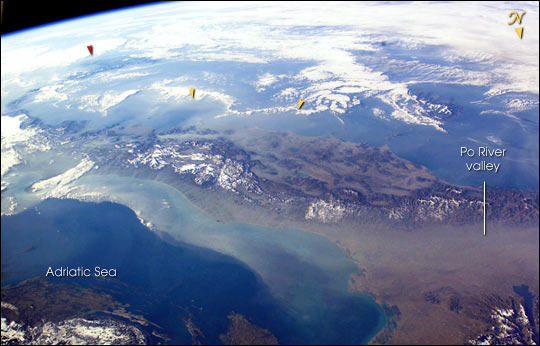
Smog as seen as brown cloud covering most of the Northern Adriatic Sea acquired February 25, 2003.


References:
Committee on Health, Environmental, and Other External Costs and Benefits of Energy Production and Consumption. "Hidden Costs of Energy: Unpriced Consequences of Energy Production and Use." The National Academies, 2010. Web. 2 March 2012. <https://download.nap.edu/chapterlist.php?record_id=12794&type=pdf_chapter&free=1>

Friday, March 2, 2012

Peak Oil Influencing Recent Surge in Gas Prices


The price of gasoline has risen almost fifty cents since the start of 2012, and many analyst are predicting that national average per gallon could reach a record $4.25 per by late April (Kahn, 2012). Mainstream media typically attributes the rise in crude oil and gasoline prices to the volatility of international oil suppliers located in the middle east. And while there might be some truth to argument that oil prices have spiked recently as a result of growing tensions about Iran’s nuclear program (Jewell, 2012), the real underlying factor influencing rising prices is that growing demand for petroleum is outpacing the available supplies.
Without delving too deep into specifics, the concept of Peak oil theory holds that at some point the global community will reach a point of maximum worldwide petroleum extraction; as a result of this peak “the production of easily accessible oil and gas will not match the projected rate of demand growth” (Ross, 2011). Estimates of when peak oil production occurred or will occur range anywhere from 2005 to 2020 (Kuhlman, 2012).
Many individuals skeptical of this theory claim, among other things, that there are still large amounts deposits of oil that have yet to be discovered. These opponents of peak-oil theory believe that our technological capabilities will spur future discoveries and increased capacity for extraction. What these individual are failing to recognize is that “there have been no significant discoveries of new oil since 2002” (Kuhlman, 2012), and that the locations where new discoveries might be found—the ocean—are the most difficult and inefficient areas for extraction. For example, “oil and natural gas production fell 9 percent in the fourth quarter [of 2011]. That's despite the $20 billion a year the company has spent since 2007 to find new sources. At Chevron, production levels last year were the lowest since 2008” (Jewell, 2012).
 “Oil and gasoline prices are expected to keep rising because global consumption continues to outstrip production.” (Jewell, 2012). It is not unfathomable to assume that prices could reach $5.00 per gallon by the middle of the summer, which will undoubtedly add to what is shaping up to be a highly contested and contentious presidential campaign, where energy and the economy will be the two most talked about issues. No one can say for certain when Peak Oil production will occur, as gas and oil do not have to disappear entirely, nor do gas prices have to rise into the stratosphere before Peak Oil’s impact is felt” (Turcotte, 2012). It is likely that we are still a few years away from experiencing the severity of this impact, but sooner or later, we all will.


                                                     List of Work Cited

Jewell, M. (2012, March 2). Rising Gas Prices Aren't Lifting Big Oil Stocks | News |                      Manufacturing.net. Manufacturing.net | The Leading Source for Manufacturing News and Insight. Retrieved March 2, 2012, fromhttp://www.manufacturing.net/news/2012/03/rising-gas-prices-arent-lifting-big-oil- stocks
Kahn, C. (2012, March 2). The Associated Press: Gasoline prices rise for 24th day. Google.           Retrieved March 2, 2012, from http://www.google.com/hostednews/ap/article/ALeqM5gdaBAArCNUc66IVYgkpHjitEob  Nw?docId=8dacc3dddc504fc4a2254eacbd104a36
Kuhlman, A (2012, March 2). :: Peak Oil: The End of the Oil Age ::. :: Peak Oil: The End of the Oil Age ::. Retrieved March 2, 2012, from http://www.oildecline.com/
Ross, R (2011, March 2). Shell Study Affirms Peak Oil Theory | The Pelican Post. The Pelican       Post: Louisiana Politics and Policy. Retrieved March 2, 2012, from   http://www.thepelicanpost.org/2011/03/02/shell-study-affirms-peak-oil-theory-3/
Turcotte, R. (2012, February 8). Rising Gasoline Prices & The Phony Blame Game - Peak OilMatters. Peak Oil Matters - A fresh perspective on the concept of peak oil and the    challenges we face. Retrieved March 2, 2012, from http://peakoilmatters

Thursday, March 1, 2012

Presidential hopefuls promise cheaper gas


Now that its election season, candidates have once again decided to focus their attention on oil in an effort to gain political support amongst voters. Just recently, presidential hopeful Newt Gingrich made the claim that if he were elected he could drop gas prices down to $2.50 a gallon. By deregulating on/off shore drilling, building the Keystone pipeline and increasing petroleum production by tapping into the vast amount of oil shale reserves throughout the US, Newt Gingrich could deliver on his promise if he’d were to be elected to the oval office. This plan will also decrease our dependency on foreign oil from unfriendly nations within the Middle East; most notable Iran. Gingrich’s proposal resonates loudly amongst voters who are worried about their saving and high unemployment, but is it practical?


Gingrich’s propositions are mostly based on oil shale extraction called hydraulic fracking, a refinement method that carries enormous ecological repercussions. According to environmental experts fracking can be linked to dozens of ground water contamination resulting in high levels of methane in the affected areas drinking water. Chemical that are used during the extraction process manages to seep into the natural aquifers making the tap water unsuitable for drinking. Residents in and around natural gas pumps post videos of igniting running tap water with a cigarette lighter.


In the end, most analyst discredit Gingrich’s ability to deliver on such a promise. A fact check done by NPR states that, “Gas prices follow oil prices, and oil prices have been rising. The price of the foreign oil that's imported by most U.S. refineries and turned into gasoline and other fuels has risen 11 percent so far this year, to about $119 a barrel, because of tensions with Iran, a cold snap in Europe and rising demand from developing nations. Oil produced in the U.S. and used by refineries in the middle of the country to produce gasoline is up 4 percent to about $103 a barrel, 19 percent higher than a year earlier. No presidential "big idea" can reverse those forces.


Resources


Cancer Causing Lip Balms, Glosses, Sticks


Petroleum is in SO many makeup and skin products it is scary. Some people may say, “Who cares?” But, you should care, since it can give people horrendous cancers in one’s latter years. Petroleum is particularly prevalent in women’s and girl’s lip balms, glosses and lipsticks. It is also referred to as “Vaseline” which many people apply to their face, because it can make the skin smooth.

The danger is that petroleum is considered a refined plastic. It will never decompose in your body, nature, or on any type of machinery. Using petroleum (aka Vaseline, lip gloss/balm, etc.) on your lips is the WORST place to put it. You will unintentionally swallow or absorb the substance and it will accumulate in your digestive track. This either causes diarrhea for some and cancers for others.

If you use petroleum year-after-year, in the long-run, it will inhibit the skin's ability to rid itself of toxins.

Some solutions to avoiding this ubiquitous product are to use these alternative ones: 
To help moisturize the skin or lips:
  • Vitamin E oil
  • jojoba oil
  • coconut oil
  • glycerin

And, if you still are not happy with these alternatives, here is a wonderful recipe that allows you to make your own 100% petroleum-free lip balm: http://naturalmothersnetwork.com/natural-health/natural-beauty/homemade-lip-balm/
If you are curious to see what is in your makeup, lotion, and other hygienic products, here is a resource that rates the danger of each product: http://www.ewg.org/skindeep/

Recycle & Earn Rewards At The Same Time!


Can an iPhone app help save the planet? Well, it is certainly going to try! Preserve, one of the leading sustainable consumer goods companies has joined forces with Recyclebank, a company that rewards people for ‘going green’ by offering discounts & deals in exchange for their efforts. The hope is that this partnership with increase participation in the Preserve Gimme 5 Program, a recycling system that provides expanded recycling options for #5 plastics and encourages recyclers to take a proactive approach to helping drive changes in the US’s recycling system.

The new app for iPhones allows you to look up the #5 collection area closest to you. There are over 200 drop off locations around the country. Through the app you also earn Recyclebank points and build your total up to receive rewards--including discounts, free offers and gift cards! You can find out more and download the application by visiting mygimme5.com.

This is certainly an innovative way to promote recycling, especially considering how popular the iPhone is. Plus creating apps is a heavy trend right now that seems to yield positive results. Also, the enticement of earning rewards is another strategy that will hopefully get people off their couches and making changes that can help the environment.


Sources: