
Welcome to EcoLife! This blog, which is hosted by Portland State University students, aims to motivate, inform, and inspire change. We want you to learn about the complicated issues surrounding homelessness, while going beyond the tip of the iceberg. We hope to establish a connection with you through our posts regarding the lives and experiences of homeless individuals, expressed in these numerous stories and articles. We hope you enjoy our blog!
Showing posts with label fashion. Show all posts
Showing posts with label fashion. Show all posts
Friday, August 5, 2016


Thursday, August 4, 2016
Vegan Leather Part 1
Vegan Leather Pt. 1: Pineapple.
Could the Pineapple plant really offer a viable alternative to animal leather?
The fur industry has had a long history of conflict with animal rights groups due to their methods of production, but leather hasn't received quite the same level of attention. We know fur comes from skinning animals, but so does leather. It doesn't take much to understand why neither of these products can be produced humanely; a quick Google search can provide more gruesome details than one would like to know (I won't post them here).
What if there were an alternative material? One that provided the same or similar quality and texture without the suffering of animals and factory workers alike?
Tuesday, August 2, 2016
Quantifying Your Closet Part 2
In a previous post, we discussed a few statistics to help us measure our wardrobe's sustainability. Now, we are going to put this into practice with an Excel spreadsheet. The spreadsheet consists of three sheets - Summary, Inventory and Daily Log - which are discussed in turn below.
Summary

This sheet serves two purposes: it provides a few auto-updating statistics about your wardrobe (as seen in the image above) and it is also where you will configure the spreadsheet to best meet your needs.
The first configuration option is referred to as a category, which is something every apparel item will be associated with. A category represents a class of apparel such as footwear. This information will used to populate the pie chart seen above and as a means of sorting your inventory (as discussed below).
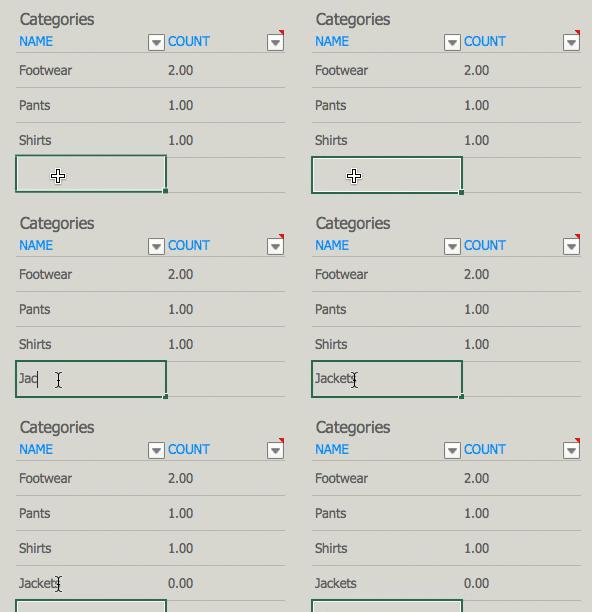 |
| Adding a 'Jackets' category |
To enter a new category or edit an existing one, simply click on the desired cell and type a category name. The COUNT cell is automatically calculated and represents the number of items associated with a particular category in your inventory.
The second configuration option are your brands. Every brand will have an associated score, which you will get from Rank A Brand.
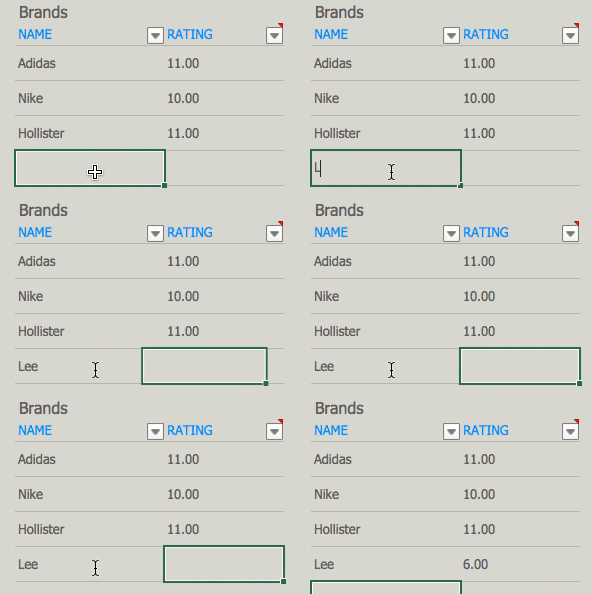 |
| Adding Lee and its Rank A Brand score |
As with categories, you can add as many brands as you want. With each brand, you also need to input a Rank A Brand score. If you disagree with a ranking or one of your brands is not ranked, you can input your own score as well (here is an example report, should you want to independently research a brand).
Inventory

This sheet is where you will add your apparel items. Each item needs to have a brand, category, type, name, purchase date and cost.
An item's type is a means of grouping items across categories (whereas categories group across types). For example, you may have items with a type of Running within both the Footwear and Shorts categories. An item's name is what you will refer to it in your Daily Log (see below). It can be anything from a model such as "Adizero Tempo 8" to a personalized name like "my favorite jacket."
After filling in the required information, Brand Rating, Item Age, Wear Count and Cost-Per-wear will be calculated for each item. You can read more about these statistics in our previous post.
An item's type is a means of grouping items across categories (whereas categories group across types). For example, you may have items with a type of Running within both the Footwear and Shorts categories. An item's name is what you will refer to it in your Daily Log (see below). It can be anything from a model such as "Adizero Tempo 8" to a personalized name like "my favorite jacket."
 |
| Auto-calculating inventory cells |
After filling in the required information, Brand Rating, Item Age, Wear Count and Cost-Per-wear will be calculated for each item. You can read more about these statistics in our previous post.
Daily Log
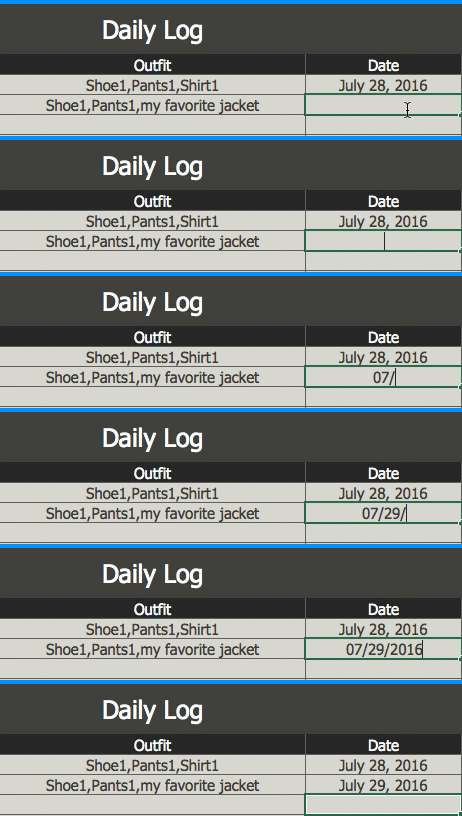 |
| Adding a Daily Log entry |
This is where you will enter your outfits on a daily basis. An outfit log consists of a comma-delimited list of items addressed by their name (as described in the previous section). Here is an example outfit log:
shoe1,pants1,shirt1
where shoe1, pants1 and shirt1 are names of items in our inventory. Wear Count (as mentioned in the previous section) is calculated based on the number of times an item appears in your Daily Log.
General Workflow
On a typical day, you should only need to create one or more entries in your Daily Log. When you purchase a new item, you'll want to update your inventory and possibly your brands.
Download
You can download the spreadsheet here. It should work as intended with any version of Microsoft Excel. Google Sheets, however, seems to change the styling a little.
On a typical day, you should only need to create one or more entries in your Daily Log. When you purchase a new item, you'll want to update your inventory and possibly your brands.
Download
You can download the spreadsheet here. It should work as intended with any version of Microsoft Excel. Google Sheets, however, seems to change the styling a little.
Monday, August 1, 2016
The Impact of the Bovine Industry -- Part 1
You may be wondering
what Bovine is? Bovine is leather that is made from cow hide. Cows are the
largest population and easiest to maintain source animals, making them the most
abundant and common leather source. Cowhide, although being one of the heaviest
and toughest leathers, is the most inexpensive due to its high availability and
resistance to dirt and water. 65% of all leather products produced around the
world are made from Bovine but how does it get made and at what costs (not
talking financially here) (Hoekstra & Chapagain, 2008) ? In this mini-series
we will be following the production of Bovine leather from cow to the making of
a Coach purse through the eyes of the virtual water and chemicals used in the
process. By the end, we will have gained a vast amount of knowledge of where
some of our favorite accessories come from and what we can do to help mitigate
the environmental impact.
Hide is a byproduct of the food
production from the source animal, in this case a cow or calf. Let us first
look at what it takes to raise this cow to get it to the proper age and weight
to begin this process. It takes three years for a cow to grow to the proper
size and weight before it can be slaughtered, this is where we get the hide
from. Over the course of these three years the cow will consume roughly 1,300
kilograms of grains (wheat, oats, barley or corn) and 7,200 kilograms of
roughages (pasture, dry hay or silage). The production of all these grains and
roughages requires roughly 3,060,000 liters of water. The cow will drink almost
24,000 liters of water as well. Finally, approximately 7,000 liters of water
will be used in servicing the farmhouse and for the slaughtering process. So
far this is a total of 3,091,000 liters of water to produce roughly 537 kg cow
itself or about 7,756 liters per kilogram (Hoekstra & Chapagain, 2008) . This is where the tradeoff
of the weight of the hide in proportion to the weight of the cow comes in.
The amount of “green”, unprocessed, hide that comes from a cow is
roughly 10% of the weight of the cow itself (Hoekstra & Chapagain, 2008) . Let us use the weight
of the example cow above to figure out how much green hide will come from this
cow.
(537 kg)/cow × .10=53.7 kg⁄cow
53.7 kg of green hide comes from
our example cow. Tune in next time to learn how leather is tanned and the harm
that can occur to the environment from this process.
Sources Used:
Hoekstra, A. Y., & Chapagain, A. K.
(2008). Globalization of Water: Sharing the Planet's Freshwater Resources.
Oxford: Blackwell Publishing.
Monday, July 25, 2016
Quantifying Your Closet
In this post we will discuss some ways that you can track the eco-friendliness of your wardrobe, which we will collectively refer to as your Sustainability Score. While this is no doubt far from a perfect science, there are a few straightforward statistics that we can use to analysis our apparel decisions.
As we cover each individual Sustainability Score factor, we will reference the following data:
Brand Cost Purchase Date Wear Count Nike $110.00 04/06/2014 100 Vans $62.00 02/08/2016 5 Levi's $69.50 07/22/2015 10 Hollister $9.95 09/16/2012 40
Brand Rating (BR)
As discussed in a previous post, there is a website called Rank A Brand that "assesses and ranks consumer brands in several sectors on sustainability and social responsibility." Each brand is ranked on a scale of 0 - 32, with 32 being the most sustainable. We will use these rankings as our first factor.
To find a rating, we go to Rank A Brand's search page and type in our brand's name. This gives us ratings of 10, 5, 11 and 3 -- for an average Brand Rating (ABR) of 7.25. This is definitely on the low side, as we want to get as close to 32 as possible.
Item Age (IA)
The goal of this factor is to avoid a high apparel turnover rate. We do this with the following formula:IA = [months since purchase] / 6
This rewards us for every 6 months we own an item. In other words, our sustainability score will increase as our average item age increases. For our first item, the calculation is:841 days / 30.1467 = 27.89 months / 6 = 4.65
Repeating the above calculation for our other items gives us IAs of 4.65, 0.93, 2.04 and 7.78, and a median Item Age (MIA) of 3.33 (note: we use a median instead of a mean to avoid giving too much weight to any particular item).
Cost-Per-Wear (CPW)
This factor is easily the most used and its formula is also quite simple:CPW = cost / [times worn]
Essentially, it is designed to reward high usage of apparel: every time you wear an item, you decrease its CPW. Using our example data, we get CPWs of $1.10, $12.4, $6.95 and $0.25. This gives a median CPW (MCPW) of $4.03.
Sustainability ScoreSS = (ABR + MIA) - MCPW
In our case, we haveSS = (7.25 + 3.33) - 4.03 = 6.55
This is obviously a pretty low score. However, we can improve our score by (1) buying from brands with a high Brand Rating, (2) keeping our apparel for as long as possible and (3) wearing our apparel as often as possible. Obviously, the best way to achieve this is to be selective with what you buy. In other words, it's much easier to meet the above criteria with a small wardrobe than it is with a large one.
What's your Sustainability Score?
(Check back soon to find out how to turn all of this into an easy-to-use spreadsheet!)
In this post we will discuss some ways that you can track the eco-friendliness of your wardrobe, which we will collectively refer to as your Sustainability Score. While this is no doubt far from a perfect science, there are a few straightforward statistics that we can use to analysis our apparel decisions.
As we cover each individual Sustainability Score factor, we will reference the following data:
| Brand | Cost | Purchase Date | Wear Count |
|---|---|---|---|
| Nike | $110.00 | 04/06/2014 | 100 |
| Vans | $62.00 | 02/08/2016 | 5 |
| Levi's | $69.50 | 07/22/2015 | 10 |
| Hollister | $9.95 | 09/16/2012 | 40 |
Brand Rating (BR)
As discussed in a previous post, there is a website called Rank A Brand that "assesses and ranks consumer brands in several sectors on sustainability and social responsibility." Each brand is ranked on a scale of 0 - 32, with 32 being the most sustainable. We will use these rankings as our first factor.
To find a rating, we go to Rank A Brand's search page and type in our brand's name. This gives us ratings of 10, 5, 11 and 3 -- for an average Brand Rating (ABR) of 7.25. This is definitely on the low side, as we want to get as close to 32 as possible.
Item Age (IA)
The goal of this factor is to avoid a high apparel turnover rate. We do this with the following formula:
IA = [months since purchase] / 6
This rewards us for every 6 months we own an item. In other words, our sustainability score will increase as our average item age increases. For our first item, the calculation is:
841 days / 30.1467 = 27.89 months / 6 = 4.65
Repeating the above calculation for our other items gives us IAs of 4.65, 0.93, 2.04 and 7.78, and a median Item Age (MIA) of 3.33 (note: we use a median instead of a mean to avoid giving too much weight to any particular item).
Cost-Per-Wear (CPW)
This factor is easily the most used and its formula is also quite simple:
CPW = cost / [times worn]
Essentially, it is designed to reward high usage of apparel: every time you wear an item, you decrease its CPW. Using our example data, we get CPWs of $1.10, $12.4, $6.95 and $0.25. This gives a median CPW (MCPW) of $4.03.
Sustainability Score
SS = (ABR + MIA) - MCPW
In our case, we have
SS = (7.25 + 3.33) - 4.03 = 6.55
This is obviously a pretty low score. However, we can improve our score by (1) buying from brands with a high Brand Rating, (2) keeping our apparel for as long as possible and (3) wearing our apparel as often as possible. Obviously, the best way to achieve this is to be selective with what you buy. In other words, it's much easier to meet the above criteria with a small wardrobe than it is with a large one.
What's your Sustainability Score?
(Check back soon to find out how to turn all of this into an easy-to-use spreadsheet!)
Saturday, July 9, 2016
Toxic Fashion
Toxic Fashion |
Image Source: Newsweek |
When we do pay attention to the impacts of our clothing choices, we tend to focus on the labor practices within the clothing industry, ensuring that our clothes are not produced by slave-labor or in factories that are unsafe for workers, especially after the Rana Plaza disaster in April of 2013 [1]. While this is important, we cannot overlook the environmental impacts of the textile industry.
The textile industry weighs heavily on our planet's resources. The raw materials needed, the chemicals used to produce and dye the fabrics, the by-products of production, the oil used to ship the materials and finished goods around the world, and the waste created when we discard our clothes (11 million tons annually in the US [2]). EcoWatch estimates that "it takes about 70 million barrels of oil just to produce the virgin polyester used in fabrics each year" [3].
While the industry has been touted as an economic driver in many developing countries, the environmental impacts are dire. The production process is water-intensive, and dirty (often compared with agriculture and oil), with a pair of jeans requiring 1,850 gallons of water from start to finish, and your average T-shirt needing 715 gallons. Rivers that used to run clean and clear to farms that produced rice, banana, coconut, turmeric, and other crops, now run red and purple with the runoff of dyes and chemicals from the factories lining the riverbanks. Locals that rely on these rivers are now at risk of serious illness [4].
While this issue is gaining more attention, oversea textile producers are resisting change. By purchasing clothing that is responsibly produced you can have a positive impact. These purchases tell producers that we want and are willing to pay for clothing that is made with eco-friendly materials and processes. A few brands that are living up to their promises of going green include: Adidas, United Colors of Benetton, Burberry, C&A, Esprit, G-Star Raw, H&M, Inditex (incl. Zara), Levi Strauss & Co., Limited Brands, Mango, Marks & Spencer, Primark, Puma, Uniqlo, and Valentino.
Others, like Georgio Armani, Bestseller, Only The Brave (incl. Diesel and Viktor & Rolf), Dolce & Gabbana, Gap Inc., Hermes, LVMH Group/Christian Dior Couture (incl. Louis Vuitton, Marc Jacobs, Dior), Metersbonwe, PvH (incl. Calvin Klein and Tommy Hilfiger), Vancl, and Versace are refusing to take responsibility for the environmental impacts of their production and currently have no intent to change their practices [5].
Links:
1. Wikipedia - Rana Plaza
2. Huffington Post - Dirty Laundry
3. EcoWatch - Fast Fashion is the Second Dirtiest Industry in the World
4. Newsweek - The Environmental Crisis in Your Closet
5. EcoWatch - How Green is Your Favorite Clothing Brand?
Friday, July 8, 2016
Sustainable Fashion And You: On Building An Eco-friendly Wardrobe
In this post we are going to discuss a question that many of us have found ourselves pondering at some point: What should I wear? That said, we will not be discussing the latest fashion trends or runway styles -- instead, we are going to look at how we can best navigate the ever-changing fashion landscape through the lens of environmental sustainability.
I am sure we are all familiar with the notion of environmental sustainability: it is the idea that we should both produce and consume in a way that, at least, attempts to limit the degradation of natural resources. However, as a consumer, it is not always so straightforward: How do we know what is, and is not, sustainable? And, equally as important, how do we know which retailers best fit the aforementioned criteria?
While these questions are not easily answered, there are some general guidelines. First, as was mentioned previously, you can rarely go wrong with either buying second-hand or making your own clothes. For many of us, however, buying mass-produced apparel - to some degree - is an inescapable aspect of our lives. With this in mind, let’s look at how we can be best informed to make eco-friendly decisions:
How does environmental sustainability apply, generally, to the fashion world?
Undress Runways provides a nice overview of the issue here. They summarize their thoughts with the following:
Sustainable fashion is about being kind to our environment, responsible with our resources and treating our fellow garment workers like human beings. This means looking at the tag, using what you have and being creative in our wardrobe choices.
They go on to explain how we must consider the process as a whole: from the materials used, to distribution, to how we care for our apparel after we have purchased it.
How can I evaluate retailers according to these principles?
This is a much more difficult question, as answers often rely on information that is nearly impossible to verify. Nevertheless, one resource which claims to address this question is Rank a Brand:
Rank a Brand is an independent and reliable brand-comparison website that assesses and ranks consumer brands in several sectors on sustainability and social responsibility. Our rankings and assessments are fully transparent.
Here is an overview of their ranking process:
- "Our rankings are based on the answers to lists of very specific, closely targeted questions."
- "Brand by brand, we scour their websites and other public sources for the answers to our carefully targeted questions."
- "For each brand, we make an online report card, which is shown on our website on the page for that brand, at the bottom of that page. Each one shows you exactly which questions we asked, and where we found the answers."
You can read the full details about how they work on this page.
A Call to Action
While we attempted to answer some key questions above, one of the most important factors in achieving sustainability is continuing to seek out information. So the next time you find yourself wondering what you should wear, perhaps you should also take a moment to evaluate how well your choices meet the criteria of sustainability.
Sunday, July 3, 2016
Agile Fashion: How Software Engineering Principles Are Being Used to Combat Waste
Inditex, a Spanish multinational clothing company, is "one of the world's largest fashion retailers with eight brands and more than 7,000 stores throughout the world."[1] As you can probably imagine, a company of this size can have a considerable environmental impact - for example, as the linked article states, "[i]f every Inditex store accidentally left on a light overnight, it would add up to almost nine years of wasted electricity."
Inditex has chosen to deal with this great responsibility in an unusual way: it has embraced principles commonly associated with a software engineering practice known as "agile development."[2] For Inditex, this manifests itself in a business model which emphasizes customer feedback over marketing already-produced merchandise:
While conventional high street retailers pre-commit about 60 percent of their production, Inditex plans only about 15 percent in advance — the rest is made in response to customer feedback.
The reasoning behind this business model is clear; if you are producing what customers want, you should be able to decrease your wasted merchandise. However, its effectiveness is less straightforward: since 2009, as the article states, Inditex as seen increases in its industrial waste and water consumption but has been able to reduce its greenhouse gas emissions. Another point of discussion is whether or not such a business model is practical for smaller retailers with significantly less resources in terms of both polling customer feedback and production.
You can read the entire article here at The Business of Fashion. Inditex also has a page dedicated to its sustainability efforts which you can find here.
Subscribe to:
Posts (Atom)