Pages

Showing posts with label Water. Show all posts

Saturday, July 9, 2016

Toxic Fashion

Toxic Fashion

A contaminated and toxic water inland water source.

Image Source: Newsweek

A popular trend in modern Western society is the focus on sustainable and environmentally-friendly products and practices, ranging from the cars we drive, the food we eat, even the light-bulbs we use, but one area of our daily lives is often overlooked: our clothing.

When we do pay attention to the impacts of our clothing choices, we tend to focus on the labor practices within the clothing industry, ensuring that our clothes are not produced by slave-labor or in factories that are unsafe for workers, especially after the Rana Plaza disaster in April of 2013 [1]. While this is important, we cannot overlook the environmental impacts of the textile industry.

The textile industry weighs heavily on our planet's resources. The raw materials needed, the chemicals used to produce and dye the fabrics, the by-products of production, the oil used to ship the materials and finished goods around the world, and the waste created when we discard our clothes (11 million tons annually in the US [2]). EcoWatch estimates that "it takes about 70 million barrels of oil just to produce the virgin polyester used in fabrics each year" [3].

While the industry has been touted as an economic driver in many developing countries, the environmental impacts are dire. The production process is water-intensive, and dirty (often compared with agriculture and oil), with a pair of jeans requiring 1,850 gallons of water from start to finish, and your average T-shirt needing 715 gallons. Rivers that used to run clean and clear to farms that produced rice, banana, coconut, turmeric, and other crops, now run red and purple with the runoff of dyes and chemicals from the factories lining the riverbanks. Locals that rely on these rivers are now at risk of serious illness [4].

While this issue is gaining more attention, oversea textile producers are resisting change. By purchasing clothing that is responsibly produced you can have a positive impact. These purchases tell producers that we want and are willing to pay for clothing that is made with eco-friendly materials and processes. A few brands that are living up to their promises of going green include: Adidas, United Colors of Benetton, Burberry, C&A, Esprit, G-Star Raw, H&M, Inditex (incl. Zara), Levi Strauss & Co., Limited Brands, Mango, Marks & Spencer, Primark, Puma, Uniqlo, and Valentino. 

Others, like Georgio Armani, Bestseller, Only The Brave (incl. Diesel and Viktor & Rolf), Dolce & Gabbana, Gap Inc., Hermes, LVMH Group/Christian Dior Couture (incl. Louis Vuitton, Marc Jacobs, Dior), Metersbonwe, PvH (incl. Calvin Klein and Tommy Hilfiger), Vancl, and Versace are refusing to take responsibility for the environmental impacts of their production and currently have no intent to change their practices [5].

Links:
1. Wikipedia - Rana Plaza
2. Huffington Post - Dirty Laundry
3. EcoWatch - Fast Fashion is the Second Dirtiest Industry in the World
4. Newsweek - The Environmental Crisis in Your Closet
5. EcoWatch - How Green is Your Favorite Clothing Brand?

Wednesday, December 11, 2013

A Killer Shine: Spotlight on Chromium

Images from Wikipedia Commons

   Chromium is a highly toxic chemical used in the production of Stainless Steel to prevent iron from rusting. When electro-plated onto other metals, it becomes chrome. In 2010, Chromium was rated by wortpolluted.org as the third greatest toxic threat to the globe, with an estimated 7.3 million people at risk within their identified pollution sites and an estimated 13-17 million worldwide. These numbers, and this degree of chromium pollution however, doesn't come from stainless steel production, but rather, the majority of this industrial waste spews from tanneries. Although the role of Chromium in tanning is something about which EcoPol has previously written, the degree of danger posed by the compound requires a second look. 
Image from worstpolluted.org
   Chromium salt, usually Trivalent Chromium, CR(III), is used to tan leather by causing the collagen within the animal hide to be cross-linked, helping the leather to take on a tougher, hardier quality. Though the chromium used in the production of tanned leather is of the Trivalent variety, CR(III)  and as a result, is considered far less harmful than Hexavalent  Chromium CR(VI), as a Bangladesh University of Engineering and Technology report authored by Avit Kumar Bhowmik and M. Samiul Islam discloses, under the heat and pressure found within the tanneries, as well as within the soil into which the toxic Chromium seeps, the mostly harmless Trivalent Chromium quickly changes its molecular structure, and forms Hexavalent Chromium, CR(VI). Hexavalent Chromium, Cr(VI), is toxic and carcinogenic, and can be mutagenic when inhaled. In a 2001 WHO report, the Hazaribagh tanneries employ over 8,000 workers who suffer from dermatological, gastrointestinal, and other diseases, while over 90% of their total employees die before the age of 50.
   These numbers, certainly, are shocking, and beg the question: why is it that work requiring chemicals as toxic as chromium being done in nations so impoverished, within facilities that lack the infrastructure necessary to properly filter and prevent the spread of these toxins? The answer, of course, much like the problem, is complex and interwoven, as the EcoPol project has previously detailed. As we at the EcoPol project have also previously written,  the stability and economic state of these nations leave them particularly susceptible to bribery, but the poverty of the nations has another draw; low income areas mean low income workers who are willing to do more, and take more risks for far less pay. The result? Areas like Hazaribagh make prime locations for cheap leather due to the low overhead. Although this cost may be negligible in dollars, as previously detailed by the EcoPol project, the remaining balance is paid in health risks and deductions from the quality of human life.

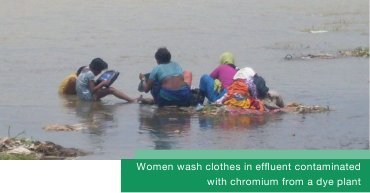
   These low labor and material costs have led to the majority of the world's tanning activity to occur in low and middle income nations. The cost savings in legal currencies add up to low levels of environmental protection, low amounts of filtration and environmental restoration, and little to no care or concern given to the well-being of the employees. The low costs overall trickle down to low costs spent on environmental protection and  as a result, the toxins trickle out of the refineries. Chromium exposure affects most of the workers through inhalation at the work site, and those around the tanneries are, in turn, poisoned as the Chromium effluent seeps into the nearby rivers and streams, leeches into the topsoil, and makes its way into ground water and drinking water supplies. These local rivers and streams are then used for bathing, dish and clothes washing, and sometimes by children for swimming.
Image from worstpolluted.org
  Chromium pollution is also caused by the large amounts of skins, hides, and fats that are dumped onto riverbanks and fields nearby populated areas, causing further pollutants to leech into the soil, such as cadmium, nickel, and lead. These toxins, alongside chromium, can, as they mix with water, then make their way into crops that have been watered with the contaminated water sources. These chromium-laden solid wastes, such as the skins and fats, are also often converted to chicken feed, which then contaminates livestock and the humans who eat the tainted meat. Another route of chromium exposure through food sources comes when the water polluted with chromium seeps into the seas and rivers, contaminating the area's fish and shellfish, which are often a food source for the local populations.

   Chromium pollution and the horrific human effects it causes is a major problem caused by tanneries. Much like the EcoPol project wrote about China,  the main vector by which this poison is spread is the water. And also like in China, these pollutants, once in the waterways, continue to cause widespread repercussions as the pollutants circulate and are bathed in, drank, and eaten. However, there is hope. The Blacksmith Institute has had success using electron donors into well water which converts Hexavalent Chromium, Cr(VI) to the less toxic Trivalent Chromium, CR(III). Further treatments, such as bone charcoal, and salt-tolerant bacteria, introduced into the contaminated soil areas, can further reduce the amount of chromium that has been absorbed into the land. In combination with these treatments, secured landfills and waste treatment facilities can further greatly reduce the health risks posed by this killer compound. 

Friday, December 6, 2013

China: Water, Water... Nowhere. And Less than 23% to Drink.

Sowing the seeds of awareness and alerting others to the damage caused by the leather industry is the first, and arguably, one of the most vital steps in halting the deluge of harmful effects that stream from leather producers that neglect to engage in even the most basic environmental protection and employee safety protocols. After all, those of us here at the EcoPol project have made this our mission for the Fall 2013 term. However, in attempting to rally others to the cause­, in effort to prevent the problem from appearing too vast, too amorphous, and too unsolvable, I find myself wanting to fixate upon one example as an illustration of the illnesses present within the light leather manufacturing field and I begin to come down with environmental myopia. For myself, that myopia leads me to focus on the now notorious tannery districts of Harzaribargh. Sure, these tanneries are a perfect example of the problems present within the leather industry, but they are also an example of an example that all too easily becomes the only instance of environmental damage caused by the leather industry that we see. However, although the images and stories  that seep from that tainted tannery district like so much effluvium are indeed useful tools in utilizing real world events to instill an emotional resonance in our reader, it is imperative that this single example remain just that- a single example among myriad more. But if we fixate too ferociously or too frequently upon one, then all of the interconnected environmental issues woven together can be too easily overlooked, and the bigger consequences to which these cascading environmental issues may lead may approach without us ever noticing.
To find another instance in which the leather industry is generating massive profits by failing to prevent the generation of massive amounts of pollution, we need only look to the nation that leads the pack in leather production. China has steadily produced over 2,000,000,000 square feet of bovine light leather each year since 2001 and in the first nine months of 2013 alone completed the export of 60.2 billion USD worth of leather, at an increase of 8.6% more leather exported than during the same period in 2012. There's no question that year by year, China tans more hides than any other nation, but as we have all seen, the process of tanning leather leaves behind byproducts and pollutants that threaten the environment and any life that comes into contact with them. This is cause for concern when we consider that China is producing such large amounts of leather, and has historically been known for large numbers of leather producers that ignore environmental regulations and restrictions in favor of cheap labor and low manufacturing costs. Although organizations like the China Leather Industry association (CLIA) have partnered with environmentally-focused NGOs, the Chinese Federal Government, and the International Leather Working Group, industrial pollution from processes such as leather tanning have already created an immense pollution problem in China, a nation with a population that is disproportionately high when compared to its water resources. To further imbalance this already top heavy ratio, in 2009 alone, the Chinese leather industry was responsible for discharging more than of 249,000,000 cubic meters of waste water.
The ripple effects caused by this water pollution are where we see how crucial it is to never become myopically fixated upon a single instance of a greater problem, because it is in China's water where the interconnected nature of these aforementioned environmental issues become evident. This water pollution by the Chinese leather industry is depleting the already low levels of usable and potable water that China has. China's population comprises 20% of the world's people, and yet only has access to 7% of the world's freshwater supply. Furthermore, of that 7%, the vast majority of China's freshwater is so polluted that it's unfit for consumption; 77% of key lakes and reservoirs, 50% of city groundwater, and 43% of major river basins are all non-potable. The chromium pollution from the effluents of China's leather industry and the negative health effects that it poses is bad enough, but when viewed in the greater context of China's water crisis, this ties the leather industry to deteriorating global water-nomics. As China Water Risk, a non-profit organization dedicated to the study and abatement of China's water Crisis points out, this water crisis not only effects the other nations dependent upon China for water by decreasing the supply of freshwater while the demand continues to increase, but can also have long-lasting and far reaching impacts upon power, trade, and can lead to civil unrest and even out-and-out warfare between nations for control of the water supply.
China's leather industry's continued growth and its immense fiscal profits come at a cost of more than just the lives lost and health being ruined right now by the current conditions around the areas tainted by the chemicals used for tanning. In the example of China's leather industry, we see how far-reaching the environmental issues of leather production are, and how many other future disasters,  whether caused by man-made conflicts for control of natural resources or pollution-based blowback from decades of disregard for how delicately interwoven are the elements of our environment.