Pages

Showing posts with label toxins. Show all posts

Wednesday, December 11, 2013

A Bribe by any Other Name

   Human Rights Watch reports that the infamous businesses responsible they have coined Bangladesh's "Toxic Tanneries" have been fined for their excessive pollution. As extensively documented by Human Rights Watch, and mentioned many times by the EcoPol Project, these Hazaribagh tanneries are the source of immense environmental damage to the region, their employees, and anyone living nearby. An official in Bangladesh's Environment Department is quoted as having told Human Rights Watch that there exists neither monitoring nor enforcement of the tanneries' 
   In spite of this, fines were levied against two of the tanneries, the Bay Tanneries and the Ayub Brothers tannery, charged $50,000, and $25,000 respectively. Human Rights Watch is unsure of why these two tanneries were chosen to be the recipients of fines when nearly  150 tanneries in the Hazaribagh district of Dhaka collectively discharge nearly 21,000 cubic meters of waste, without any pre-treatment to abate the levels of toxins.  These toxins are responsible for the painful dermatological diseases as well as the respiratory and gastrointestinal illnesses all too common in Dhaka. Nonetheless, Ayub Brothers and Bay Tanneries were singled out and fined for not having effluent treatment plants that would filter their wastewater and diminish the amount of poison being pumped out by their leather processing facilities.
   90-95% of the tanneries in Bangladesh are located within the Hazaribagh neighborhood of Dhaka, employing between 8,000 and 12,000 people, and the excessive toxic waste being excreted by these tanneries has led to a foul, chemical smell in the public water and air. In this slum, corrugated tin is often used as construction material, but the quantity of pollutants present causes the metal to deteriorate at a rapid rate. Residents report that within six months, the metal is corroded and requires replacement. It is hard to hear about such horrid conditions, and yet, we hear about them, or others similar, on a nearly daily basis.
Children in a Hazaribagh Tannery. Source: AP
   But as hard as these atrocities are to hear about, it is far harder to understand why so few tanneries were fined when conditions such as these are so prevalent. It is harder to understand why only two tanneries were chosen to pay such negligibly low numbers when so many tanneries are responsible and making such monumentally massive sums of money. No doubt, it is far harder to try and comprehend the small sum charged than it is to read the depictions of such deplorable conditions. It is hard to attempt to comprehend why so little is done in a neighborhood where there are so many thousands for whom employment is synonymous with poisoning, and where so many tens of thousands more are essentially punished because they happen to live within the pollution and poverty provided by the neighborhood leather industry without receiving any information given about the potential harmful effects of the chemical compounds they have as neighbors.
   In a little over a year, between June of 2011 and July of 2012, these tanneries exported almost $663,000,000 in leather goods. Yet the total fines that were levied against the two tanneries unlucky enough to actually receive a penalty added to a paltry $75,000.  Not only that, but although Bangladesh's Environment Department assessed the fine, there is no information given about how the money will be used, about whether the fines will be used to help construct waste treatment plants or, at the very least, about whether the fines would repeat for those two tanneries each year that they are out of compliance, or whether other tanneries will be fined in future if they fail to produce wastewater treatment plants. The Environment Department also failed to explain the reasoning behind deciding upon such small sums for the fine. 
   To be an efficient deterrent, fines for being out of compliance with environmental standards are there to encourage businesses to adhere to those policies. The amounts fined should to be large enough that they produce a substantially negative impact upon the profits of businesses fined. These fines should also be large enough that, upon performing a profit/loss analysis, each business would determine that the cheaper option is to simply comply with the environmental guidelines.
Worker at a Dhaka Tannery with Tannery Waste. Source: AP
   When considering the total devastation in the area, the immense loss of life, the damages and health issues caused, and the long term complications that will continue to arise in the region, these fines are far from fine. There was less than $100,000 charged in total, divided between two out of 150 tanneries, and likely to make so minor an impact upon their profit margins as to be almost non-existent. These negligible fines are certainly not enough to make the costs of installing and operating a wastewater treatment facility cheaper than paying fines. As the EcoPol project has detailed, bribery is a huge issue that surrounds the tannery industry.

   And it is for all these reasons that I cannot help but wonder if these "fines" are a bribe by any other name. The fines came just four months after Human Rights Watch's report on the Hazaribagh tanneries drew unparalleled levels of attention to their activities. The timing is questionable and has the markings of a PR cleanup attempt, rather than an environmental one. These fines, seemingly randomly assigned,  collected without disclosure about where the funds will be allocated, and shockingly small in comparison to the total profits of these companies, strike me as a new type of bribe. One that can be made above board instead of under a desk, in plain view, allowing the corrupt officials to receive their funds while appearing to be cracking down on environmental issues in their districts, while in actuality, continuing to allow business as usual, and profiting from the proliferation of pollutants, all the while pretending to be working against it.

A Killer Shine: Spotlight on Chromium

Images from Wikipedia Commons

   Chromium is a highly toxic chemical used in the production of Stainless Steel to prevent iron from rusting. When electro-plated onto other metals, it becomes chrome. In 2010, Chromium was rated by wortpolluted.org as the third greatest toxic threat to the globe, with an estimated 7.3 million people at risk within their identified pollution sites and an estimated 13-17 million worldwide. These numbers, and this degree of chromium pollution however, doesn't come from stainless steel production, but rather, the majority of this industrial waste spews from tanneries. Although the role of Chromium in tanning is something about which EcoPol has previously written, the degree of danger posed by the compound requires a second look. 
Image from worstpolluted.org
   Chromium salt, usually Trivalent Chromium, CR(III), is used to tan leather by causing the collagen within the animal hide to be cross-linked, helping the leather to take on a tougher, hardier quality. Though the chromium used in the production of tanned leather is of the Trivalent variety, CR(III)  and as a result, is considered far less harmful than Hexavalent  Chromium CR(VI), as a Bangladesh University of Engineering and Technology report authored by Avit Kumar Bhowmik and M. Samiul Islam discloses, under the heat and pressure found within the tanneries, as well as within the soil into which the toxic Chromium seeps, the mostly harmless Trivalent Chromium quickly changes its molecular structure, and forms Hexavalent Chromium, CR(VI). Hexavalent Chromium, Cr(VI), is toxic and carcinogenic, and can be mutagenic when inhaled. In a 2001 WHO report, the Hazaribagh tanneries employ over 8,000 workers who suffer from dermatological, gastrointestinal, and other diseases, while over 90% of their total employees die before the age of 50.
   These numbers, certainly, are shocking, and beg the question: why is it that work requiring chemicals as toxic as chromium being done in nations so impoverished, within facilities that lack the infrastructure necessary to properly filter and prevent the spread of these toxins? The answer, of course, much like the problem, is complex and interwoven, as the EcoPol project has previously detailed. As we at the EcoPol project have also previously written,  the stability and economic state of these nations leave them particularly susceptible to bribery, but the poverty of the nations has another draw; low income areas mean low income workers who are willing to do more, and take more risks for far less pay. The result? Areas like Hazaribagh make prime locations for cheap leather due to the low overhead. Although this cost may be negligible in dollars, as previously detailed by the EcoPol project, the remaining balance is paid in health risks and deductions from the quality of human life.

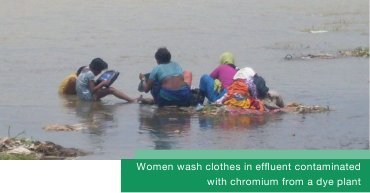
   These low labor and material costs have led to the majority of the world's tanning activity to occur in low and middle income nations. The cost savings in legal currencies add up to low levels of environmental protection, low amounts of filtration and environmental restoration, and little to no care or concern given to the well-being of the employees. The low costs overall trickle down to low costs spent on environmental protection and  as a result, the toxins trickle out of the refineries. Chromium exposure affects most of the workers through inhalation at the work site, and those around the tanneries are, in turn, poisoned as the Chromium effluent seeps into the nearby rivers and streams, leeches into the topsoil, and makes its way into ground water and drinking water supplies. These local rivers and streams are then used for bathing, dish and clothes washing, and sometimes by children for swimming.
Image from worstpolluted.org
  Chromium pollution is also caused by the large amounts of skins, hides, and fats that are dumped onto riverbanks and fields nearby populated areas, causing further pollutants to leech into the soil, such as cadmium, nickel, and lead. These toxins, alongside chromium, can, as they mix with water, then make their way into crops that have been watered with the contaminated water sources. These chromium-laden solid wastes, such as the skins and fats, are also often converted to chicken feed, which then contaminates livestock and the humans who eat the tainted meat. Another route of chromium exposure through food sources comes when the water polluted with chromium seeps into the seas and rivers, contaminating the area's fish and shellfish, which are often a food source for the local populations.

   Chromium pollution and the horrific human effects it causes is a major problem caused by tanneries. Much like the EcoPol project wrote about China,  the main vector by which this poison is spread is the water. And also like in China, these pollutants, once in the waterways, continue to cause widespread repercussions as the pollutants circulate and are bathed in, drank, and eaten. However, there is hope. The Blacksmith Institute has had success using electron donors into well water which converts Hexavalent Chromium, Cr(VI) to the less toxic Trivalent Chromium, CR(III). Further treatments, such as bone charcoal, and salt-tolerant bacteria, introduced into the contaminated soil areas, can further reduce the amount of chromium that has been absorbed into the land. In combination with these treatments, secured landfills and waste treatment facilities can further greatly reduce the health risks posed by this killer compound. 

Tuesday, July 31, 2012

Toxic Tuesday: 2-butoxyethanol


Get to know the ingredients in your household cleaners.
By Stacy Peltier

What is it?
2-butoxyethanol has a plethora of unpronounceable names, and so is commonly abbreviated as simply BE or EGBE (for ethylene glycol monobutyl ether, if you must know). This organic compound can be found in the air, water, or soil, but most important is its solubility property. When 2-butoxyethanol is mixed with water or other organic solvents, it form a single layer – unlike a mixture of oil and water where the oil sits separately on top. It is usually found as a solvent in general surface cleaners, window cleaners, floor strippers, and spot and rust removers.

Why is it used in household cleaners?
EGBE is an inexpensive solvent that doesn’t evaporate easily. This, combined with its modest surfactant properties, makes it an easy ingredient for companies to use in basic household cleaners and degreasers.

How can it be toxic?
Mehhh, the severity of 2-butoxyethanol is still pretty questionable. Acute exposure can certainly cause irritation in the eyes, nose, throat, and respiratory system, but most studies conclude that the general public has minimal health risks associated with EGBE. Most of the toxicity scare is based on the fact that it is in a chemical group called the “glycol ethers,” of which other members can cause reduced sperm counts in men and reproductive or birth defects in women. However, these effects due specifically to EGBE can only be found in tests conducted on animals – each of which shows a markedly harsher result than the same tests conducted on humans.

Environmental risk is also low since 2-butoxyethanol is biodegradable, has a low toxicity to aquatic organisms, does not bioaccumulate, and can decompose in the presence of air within a few days of exposure. The danger here may lie in landfills, where the ingredient could leach into groundwater. But once again, the known risks are minimal.

So, what can I do about it?
Although the health risks of this toxin are relatively low, it’s probably better to play it safe. Most harmful effects are caused by inhaling or ingesting the chemical, so always wear a mask and spray your cleaners in a well-ventilated room. Want to cut it out altogether? Clean mirrors and windows with newspaper and diluted vinegar and stick to simple, green cleaning products. Google search how to make your own formulas using natural household items like baking soda and essential oils.

References

Tuesday, July 17, 2012

Toxic Tuesday: Phosphates

Get to know the ingredients in your household cleaners.
By Stacy Peltier

What is it?
A phosphate is a compound containing the element phosphorous, along with various salts and other minerals. It’s important to note straightaway that they are naturally-occurring and contribute many benefits to life and its various ecosystems. For example, phosphates make up the main minerals in our bones and teeth, play a key role in how the human body metabolizes, and are vital to photosynthesis in plants. In fact, there’s even a phosphorous nutrient cycle! But as with anything, too much can be a bad thing.

Why is it used in household cleaners?
Phosphates perform three critical functions in many household cleaners. First, the presence of phosphates can control the alkalinity of a cleaner by keeping its acidity level stable. Next, their presence softens water by "holding" or removing metal ions, which allows other components in the cleaning solution to work more effectively. Finally, phosphates trap and hold any dirts and oils found on surfaces - once they are suspended in the cleaning solution instead of attached to, say, a tabletop, the particles can be easily rinsed away. They are used most often in laundry and dishwasher detergents, although some states have successfully placed laws restricting the permissible amount.

How can it be toxic?
One word: eutrophication. And that's a pretty big word, so let's break it down. In ancient Greece, 'eu' means "well", 'trope' means "nourish," and '-ication' is roughly "the process of." So how can the instigation of a well-nourished environment be bad? Well, disposed phosphates work their way into the aquatic environment via sewage systems and overstimulate the growth of algae and other aquatic plants. This not only depletes normal oxygen levels but matures the lake ecosystem at an alarming rate... fish eventually die off and are replaced with scavenging critters. Although some may argue this is a natural process, what human pollution has done in tens of years would normally take our planet thousands of years to achieve.

So, what can I do about it?
Phosphate-free detergents (for both clothes and dishes) are finally starting to retain the helpful cleaning characteristics of phosphates without the harmful environmental side-effects. Before you make a purchase, check the label for zeolites, polycarboxylic acid, surfactants, or sodium carbonate  - any of these are greener alternatives to this potentially toxic ingredient. Many new detergents actually advertise the fact that they are "Phosphate-Free!" on the outer packaging of the product. Want to go big? Check out state legislation laws on these cleaners. Although many consumer detergents already have major restrictions in place, there is currently little to no laws addressing the use of phosphates in fertilizers and industrial-use detergents.

References