Pages

Monday, December 16, 2013

Hazaribagh Tannery District - The Sixth Most Polluted Place on Earth

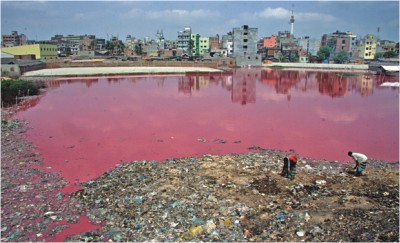
Hazaribagh. The name means 'thousand gardens', but the historically whimsical name fits now as much as Hong Kong still meaning 'fragrant harbor'. Once, Hazaribagh may have been a paradise, and perhaps some pockets of it still reach for that golden past. The reality now is that the city is the sixth out of ten most polluted spots on the planet, according to a Green Cross of Switzerland study. Of the 270 registered tanneries in Bangladesh, 90% of these are located here, dumping 22,000 cubic meters of waste water each day. Waste water that includes hexavalent chromium, a heavy metal responsible for lung cancer, stomach and intestinal ulcers. Only two of these tanneries have any kind of waste treatment facility, but if more were added, clean-up would still take many years. There is a long road to travel before it becomes a thousand gardens again, but the journey of a thousand miles begins with a single step.

Environmental Concerns regarding Hazaribagh Tannery

Breakout Labs Provides Lab-Grown Leather and Meat Products

In the classic novel 'The Restaurant at the End of the Universe', the characters settle down to an evening of drinks, fine dining, and the end of the universe. Sentient beings from all around the galaxy are in attendance. From sentient mattress creatures to hyper-intelligent shades of blue; you never know who you'll meet at Milliway's. Given the wide and varied forms of life that inhabit this imaginary universe created by Douglas Adams, one can assume that the food choices would be as diverse. It was decided, instead of killing and eating things that would have rather lived out long and happy lives, to design meat that not only wanted you to eat it, but was capable of encouraging you to do so, even so far as recommending which parts of it's body it had been cultivating for maximum flavor. Well, we aren't quite to that point yet, but Breakout Labs has is in the process of 'designing' 3D bioprinted meat and leather products grown from biopsied animal tissue materials. The meats would be animal product that never came off of the animal, that caused no harm to the animal, and produces fewer harmful environmental byproducts.

Tissue-Engineered Leather Could be Mass-Produced by 2017

Breakout Labs Announces Newest Grants at the Intersection of Biology and Advanced Technologies

Modern Meadow

Presidential Green Chemistry Challenge Award for Academics


Wool inspects a shoe made from eco-leather.  
Richard Wool, a professor of chemical and bio-molecular engineering at University of Delaware, wins the Presidential Green Chemistry Challenge Award for Academics for his extensive work in developing an array of low-toxicity bio-based materials to support the green energy infrastructure. The Environmental Protection Agency awards program recognizes the design of safer and more sustainable, processes and products annually in five categories: Academic, Small Business, Greener Synthetic Pathways, Greener Reaction Conditions, and Designing Greener Chemicals. Wool created several high-performance materials using sustainable feedstocks including vegetable oils, recycled paper, chicken feathers, and flax fiber to make pressure-sensitive adhesives, composite resins, foams, and synthetic leather. Wool states that finding low toxicity replacements for commodity plastics such as polystyrene and PVC, adhesives, foams and composite resins, in addition to leather-like materials, must be a priority if we are to benefit the environment and human health. One of his more recent inventions is a breathable, eco-leather made from soybean oil and natural fiber. Wool’s start-up company, Eco-Leather Corp., avoids the traditional chemical leather tanning process and has resulted in collaborations with popular companies such as Nike and Puma to use the leather substitute in their products. 

Saturday, December 14, 2013

Tanfor T


Scientists over at Kemira, a chemical industry group, have developed a new, sustainable, chrome-free tanning system. Tanfor T is free of chromium, aldehydes, and other agents that create unwanted and expensive side-effects for tanners. It’s safe for humans and the environment and will reduce the cost of both solid and liquid waste. A high portion of Tanfor T fixes itself in the leather and what’s left of it in the bath poses no threat to the environment. It also outperforms traditional tanning systems when it comes to dyeability and only requires small adjustments to the traditional production process. Tanfor T is based on aluminum, silicates, and short chain organic acids. It offers a perfect dyeability and high dye affinity, which essentially means that it can be dyed to any color.

Salmon leather


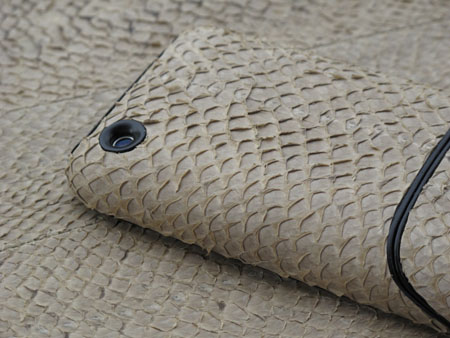
Is salmon skin fashionable? With more and more companies are taking ethical considerations with their products, it’s not surprising that entrepreneurs are coming up with innovative products. Designers and brands are beginning to look towards alternative leather options that are byproducts of other industries. Salmon processing plants discard millions of tons of salmon skin every year. Stiven Kerestegian, CEO of ES-Salmon Leather, began purchasing skins from those processing plants and believed that they could be re-purposed into something aesthetically appealing, very resilient, and flexible. They have two different lines: one that uses natural plant extracts and oils for the tanning process, and the other that unfortunately uses traditional methods such as chromium. Their goal is to have a complete line that uses only eco-friendly chemicals.


Friday, December 13, 2013

Pamela Anderson Exposes... Indian Tanneries

I admit it, I eat meat. I know that the only way to make that decision and not support the captive cruelty of the meat industry is to hunt my own food and prepare it, but as hypocritical as it makes me feel, I also don't like the idea of being the one who tracks down and shoots Bambi's mom. The thought, and the soft-focus, Disney-colored images that flood my mind soon after are enough to turn my stomach and convince me that maybe, at least for today, just ignoring the implications of whether or not me spending $3 at a grocery store is contributing to horrific animal cruelty. I'd feel worse about it, but I know that this very thought process is far from unique, and is likely a silent mental ritual that I share with so many of you, dear readers.


However, condoning the leather industry through a $3 or $300 purchase is something that, given the horrors of the video that I just saw, I couldn't bring myself to do with even the hardiest attempt to swallow my guilt. Regardless of my issues with some of the organization's tactics, Pamela Anderson Lee and PETA put together a video exposing the horrific details behind how it is that Indian Tanneries go from cow to leather. 

The video is linked below, is definitely NSFW and should only be viewed by those 18 years of age and older with strong stomachs. 

Thursday, December 12, 2013

Pleather

Fake leather, synthetic leather, artificial leather, and pleather are some of the names people might call leather made from polyurethane (PU) or polyvinyl chloride (PVC). Pleather is made up of polyurethane (fossil fuels) or other types of plastics like polyvinyl chloride, which is more commonly known as vinyl.

Activists block Terminals Pty Ltd, major
supplier of feedstock to PVC industry.


PVC production releases dioxins, persistent organize pollutants, and further toxic emissions when it's burned in garbage incinerators. The Association of Plastics in Europe (APE) states that PVC is one of earliest plastics that is derived from salt (57%) and oil or gas (43%) and according to Greenpeace, it's the second most commonly used plastic in the world and the most harmful to the environment.


PU on the other hand is not only a affordable, animal-free, leather alternative. It's recognized as being environmentally friendly, synthetic materials. Though toxicity isn't much of an issue with PU, it's still made essentially of fossil fuels, which emits carbon dioxide during production. According to APE, 3.7 pounds of CO2 is emitted when producing a pound of PU, which is a fraction of burning a gallon of gasoline (19.64 pounds). PU leather, contrary to popular belief, is actually more durable than real leather. Polyurethane itself is so versatile it's used as an insulator in many products and appliances such as refrigerators and astronaut suits. By adapting its molecules, we can give it lots of different properties. For example surfboards are made to be light yet strong, wheels on roller blades to be resistant, and automobiles for shock absorption. So if you're adamant on getting leather, be eco-friendly and consider the much cheaper polyurethane alternative.