Pages

Thursday, December 10, 2015

Why microbeads were banned in Illinois, and in why they should be in general.

The first state in the US to ban microbeads is Illinois back in June 2014, and this was done so for a variety of reasons. More specifically, the production, the manufacture, and the distribution of cosmetic products that contains microbeads was banned, and the punishment would be a $2500-5000 fine each day that the provision is violated, and comes into effect December 31 2017, as well as a ban on the purchase of microbead products that will be in effect December 31 2018, and a ban on medications containing microbeads on December 31 2019.

Many of the reasons that were used referenced various scientific articles and reports with evidence and statements showing the damage that microbeads will do to  the ecosystem. Microbeads themselves are not filtered out of sewage and therefore end up directly in the marine environment where they can cause significant harm to the fish and other sea life living in that environment. Microbeads themselves either do not decompose or decompose very slowly, including the ones described as biodegradable, and end up causing persistent damage.

While this has led to changes that were made by some corporations such as Unilever who supposedly replaced all their micro-plastic exfoliating products by 1 January 2015, there is still a fair bit of work before this can be achieved on a greater scale.

http://time.com/2917462/why-illinois-banned-microbeads/

http://www.ilga.gov/legislation/billstatus.asp?DocNum=2727&GAID=12&GA=98&DocTypeID=SB&LegID=78471&SessionID=85&SpecSess=


Wednesday, December 9, 2015

The House of Representatives Voted to Ban Microbeads

The House passed the Microbead-Free Waters Act of 2015 by unanimous voice vote on Monday, December 7th, prohibiting the sale or distribution of cosmetics containing plastic microbeads. It is now left to the Senate to approve a federal measure. The house bill would ban manufacturing of the beads starting July 1, 2017, then later banning manufacturing and sales of the beads in 2018 and 2019. Many states have already banned these plastic beads. The first state to ban microbeads was Illinois in 2014. Shortly after, Colorado, Indiana, Maine, Maryland, New Jersey, and California all have banned microbeads. The nation is on it’s way to a cleaner, safer future, but it is also up to us to make that happen. "Action at the federal level sends a strong message that the true solution to the problem of plastic pollution in U.S. waters must focus on the sources," said Molly Flanagan, Alliance for the Great Lakes vice president for policy. It is important to educate others of the harms of microbeads and to stop the use of personal care products to keep our waters clean. 


Coffee as Exfoliant? 2013 Home-Grown Company Introduces New Cosmetic Solution

I apologize for a repost of this article from Monday in The Telegraph about a group of Australian women who started a skin care brand from the ground up (pun intended) using leftover coffee grounds as the base of their line of products, Frank Body.

Bree Johnson, founder of Frank Body, cites coffee's natural antioxidants, pH balance, and stimulant properties as reasons for its use as a beauty product, as well as the coarse-ground used coffee as an effective exfoliant.

In addition to coffee, Frank Body makes use of a full line of natural body products that are 99.9% natural, microbead-free, and have minimal environmental impact.

There are plenty of alternatives to synthetic exfoliants in the world, and all we have to do is choose them to bring about the change we want. Thank you, Frank Body!

Microbeads Under International Scrutiny

While we may sometimes focus on microbeads as a local or national issue, it is encouraging to find that while the media may only cover efforts in the United States to ban the bead here, organizations and governments across the world are taking notice and beginning the process of eliminating the beads as well.

In an article from the Taipei Times dated 12/8/2015, staff reporter Chen Wei-han cites numerous studies from the United States, from Belgium, and from Taiwan's own Taiwan Watch Institute that state the hazards microbes pose to public health. "...they [Taiwan Watch Institute] have found out that about one-third of the products contained microbeads — plastic particles smaller than 1mm in diameter — that are widely used as exfoliating agents, and that a bottle of facial foam could contain up to 1 million microbeads." states TWI secretary general Herlin Hsieh in a recent report.

In addition to the findings of TWI, Wei-han's article cites recent ban measures in some U.S. states as being a catalyst for change across the world. In speaking up we enact change, not only at home but around the world. If we make changes, the world will notice. If we make enough changes, the world will follow.

   
Full text from the Taipei Times here

Progress! House of Representatives Approves Bead Ban

Big News! The U.S. House of Representatives has approved a bill banning the use of plastic microbeads in personal care products, beginning in 2017.

The Microbead-free Waters Act was championed by Representative Frank Pauline Jr. of New Jersey, and the act passed unanimously.

Reasons cited for passage of the act included biodegradable, safer alternatives, danger to the environment, and increasing pressure from state governments who have already enacted microbead bans.

Read the report here from detroitnews.com


Tuesday, December 8, 2015

Natural alternatives to Microbeads


Microbeads are very common house when it comes to exfoliation in health and beauty products, such as body and facial wash. The majority of people probably have used some kind of product at one point that contains it. We may also currently be using products that contain these toxic little beads without even knowing how detrimental they are to the environment. 

Companies may claim to use ‘natural’ exfoliants, but how do we know whether or not that is true? And if we know they are dangerous to the environment and wildlife, why do we continue to use them? One may think “Oh, they are tiny enough to just wash down the drain and dissipate. They won’t really affect the environment” or “One person can’t make that big of a difference.”, however little do we know that microbeads are sponges to various toxic chemicals. We are endangering not only the environment, but ourselves each time we use a product that contains these balls. Each bottle of facial or body wash contains roughly about 350,000 microbeads. An estimated 8 trillion microbeads washes through the US water systems daily. 

“But exfoliation is good for your skin.” Exfoliation has its benefits. They can help detoxify our skin, get rid of dead skin cells, kill bacteria that may clog up your pores, and much more. That doesn’t mean one must rely on products that contain these toxin sponges. Avoid purchasing products that contain the following in the ingredients:
  • Polypropylene
  • Polyethylene 
There are many natural alternatives that can be made using common household products including:
  • Raw honey: a staple found in many recipes for homemade cleansers, as well as containing many health benefits
  • Konjac: sponges created from the fibers of the konjac plant
  • Oatmeal: provides mild exfoliation that is gentle on dry and irritated skin
  • Yogurt: contains skin-smoothing lactic acid, and helps skin retain moisture
Sources:
http://www.nydailynews.com/opinion/john-calvelli-ban-microbeads-save-wildlife-article-1.2450893

Monday, December 7, 2015

Plastic microbeads polluting St. Lawrence River, McGill researchers find


With our ever increasing knowledge about microbeads, I wondered what is typically found in terms of volume in our rivers? Much of our discovery this term has centered on what has been found entering much larger waterways, such as the Great Lakes. So my search led me to the Saint Lawrence river, which serves as the primary drainage for the Great Lakes. It is also a part of the international boundary between Ontario Canada and the state of New York.

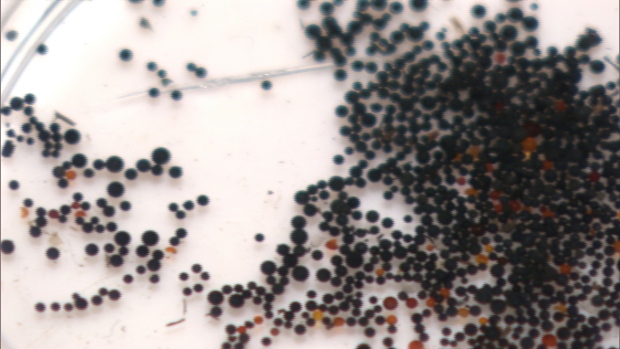
In their research, graduate students and professors from McGill University as well as the Quebec government collected sediment from various locations along the river and found an incredible amount of microbeads within those sediment samples. These samples were then sifted and the microbeads were separated, sorted and counted. The article documents that at some locations over 1000 microbeads per liter of sediment were found, According to associate professor and biologist Anthony Ricciardi, the amount was: "a magnitude that rivals the worlds most contaminated ocean sediments."

The researchers have also spent some time dissecting fish that feed along the river bed looking for microbeads inside as they concluded: "if they build up in large enough numbers as they appear to be, they can more easily enter the food chain,"(Ricciardi).
The Quebec Green party is hoping that support for Banning microbeads in the United States will give them the legislative support that they need to follow suit in
Canada.

http://www.cbc.ca/news/canada/montreal/plastic-microbeads-polluting-st-lawrence-river-mcgill-researchers-find-1.2779096