Pages

Wednesday, March 15, 2017

Negative Effects of Oil and Gas Drilling

Gas Drilling has had a negative impact on wildlife, water sources, human health, recreation and more. The noise, pollution, traffic and fences disrupt wildlife, which changes it ecologically. For one thing, large vehicles driving to gas drilling locations cause noise disruptions in songbird communication, which can affect breeding and nesting seasons. In addition to the noise disruption, toxic chemicals and dust can also pollute the air, which affects the breathing of many people living in those areas.

Oil Drilling has a negative impact, but heavier one on marine life. When oil is taken from the ocean floor, other chemicals and toxic substances come up as well, including mercury, lead and arsenic. In addition, waves from oil drilling impact sea mammals negatively, and disorient whales. This is all done, so that consumers can have petroleum to fuel cars.
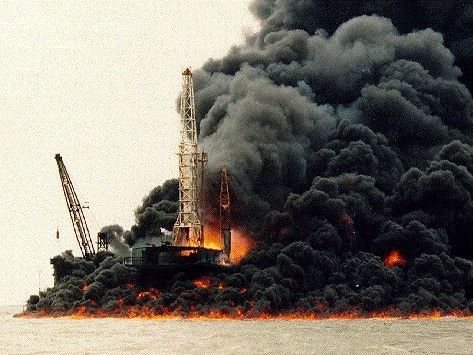
1969, the blowout of an offshore drilling platform in Santa Barbara, Calif. ultimately caused 200,000 gallons of crude oil to spread over 800 square miles (2,072 square kilometers) of ocean and shore.

References:


Tuesday, March 14, 2017

Asprin....?

Throughout the history of the U.S, we seen oil used in many various ways, commonly with transportation, cars, airplanes, and trains. Places where we do not normally see oil are in clothing, utilities, and supplies. One in particular that struck my attention was medicine; a typical every product that people use for headaches, fever and as a preventative against heart conditions or stroke. Aspirin, Ibuprofen, and Acetaminophen countless numbers of people consume this every day. Over a billion tablets are swallowed per year around the globe.


http://www.livescience.com/24752-surprising-oil-uses.html

The Downfalls of Palm Oil Production

Article 1:
Palm oil is found in every part of our lives. It can be found in lipsticks, candy bars, biodiesel and more. It is also a lot cheaper and more efficient to produce than vegetable oil. But unfortunately, there are a lot of negative side effects, such as impacting orangutans or Southeast Asian forests.


Globally, demand for palm oil has increased since the 1990s, with the United States and Europe as its top consumer. According to the Food and Drug Administration’s ban on trans fat means that palm oil is the “clear alternative” for producers. Palm oil increased by 60% when this ban was introduced.


However, palm oil plantations meant that hundreds of football field sized rainforests are destroyed every hour. While there are not dependable numbers to show what the impact of deforestation was caused by palm oil specifically, many environmentalists agree that it is one of the main factors the lead to deforestation.
Animals, and indigenous communities are threatened by the palm oil industry as well. Land owned by indigenous communities have been seized and used for palm oil plantations, and inhabitants become dependent on low-paid wage labor. Indigenous communities have also been consistently fighting against these corporations.


Palm oil industry have also been associated with widespread human rights abuse, which includes forced and child labor. Many of these laborers face awful working conditions. Although palm oil is considered a better alternative to trans fat, the production of palm oil is leading to mass deforestation, and invasion of human rights.


References:


Monday, March 13, 2017

A World Full Of Petroleum

The world is full of products that come from petroleum. As people living on this earth, we should become aware of how much petroleum we use everyday. There are many health, environmental and political reasons of why people should reduce their petroleum consumption. To quickly sum up the reasons petroleum should be reduced based on our health, environmental and political reasons is because, there is petroleum based fertilizers, toxic chemical exposure during use, pollution, climate change, and rainforest around the world are being destroyed due us relying on petroleum.


To reduce our petroleum consumption, we must understand what products that we own contains petroleum. Some of the first things that may come to mind  are gasoline, plastic, and paint. But, there are other petroleum-based products that may be directly or indirectly involved that not many people are not aware of. Therefore, becoming educated on products that contain petroleum and the issue of it is especially important.


Here are a few ways in which everyone can help to reduce petroleum consumption.
  • Drive less! It may sound hard but by taking the bike to work, taking public transit or even carpooling can help people be more sustainable.
  • Buy food in bulk! This helps to reduce plastic.
  • Grow your own vegetables or buy at a local farmer's market. This helps to reduce the transportations of these products.
  • Buy drinks that come in glass containers.
  • Don’t ever forget the term “reduce, reuse, recycle”! If we keep this concept in mind, we will be reminded that we must cut down on the waste we produce. It also helps us conserve natural resources, landfill and energy.
For more information: http://www.stonyrunfriends.org/srcms/content/what-we-can-do-reduce-petroleum-use

Oil at Your Fingertips


Did you know that 93% of plastics in the US are derived from natural gas or oil?

In a world where technology has found its way into the everyday lives of billions around the world, it's easy for us to get lost in all the advances and affordances technology has allowed us. Approaching this course and topic, I certainly never drew the correlation between just how much oil plays a part in the technology that continues to thrust us further into the twenty-first century. I think that recognizing the hidden impact oil has on our technology perfectly encapsulates the many hidden ways in which oil plays a part in dictating our everyday lives.

As I sit here, typing this blog post, I do so on a laptop, a laptop made from plastic and parts derived from the natural gases and oils of our planet. And as you read this post, be it on your laptop, your computer, your smartphone, or perhaps even your smartwatch, I hope that you too can now realize just how prevalent the presence of oil is in your everyday technology.

As a frame of reference, I ask that you please watch this brief video:


After viewing that video, how many of the electronics noted in the video are present in your lives? Now to put it into perspective, imagine just how many people across the planet use those very same electronics? In this day and age, it's almost a requirement for everyone to at least have a phone, but even beyond that, the list of everyday technological items born out of natural gases and oil is vast.

And herein lies our conundrum.

While we recognize technology continues to drive the world forward, at the same time, I think it's safe to say that we can certainly also understand the devastating impact that the oil industry has on the environment, people, communities, and countries. This leads to a very jarring dissonance where we find ourselves trying to reduce our dependence on oil, however this goes against the face of this global lifestyle that continues to place an onus on technology as being at the forefront of societal and cultural advances.

I personally think it's foolhardy (and impossible) for us to simply "end" our dependence on the oil industry, but we can certainly make a conscious and conscientious effort to recognize just how far-reaching its impact can be. For example, perhaps we can start to more actively look towards greener technology companies (such as Indian company Wipro, who found themselves topping the list of Greenpeace's Guide to Greener Electronics) that afford us the same luxuries, but at a lower risk of harm to communities and our planet. Recognizing that even our everyday technology use is made only possible because of the oil industry can go a long way towards helping bring awareness of this predicament on a larger scale.

We may not necessarily be able to end our reliance on technology, but we can certainly take control by adapting our ways of approaching it.

References:

Donovan, T. (2010, June 11). Oil Is In Everything, From Shampoo To Vitamins. Retrieved March 6, 2017, from http://www.huffingtonpost.com/2010/06/11/oil-is-in-everything-from_n_608751.html

Electronics. (n.d.). Retrieved March 6, 2017, from http://www.oilandgasinfo.ca/oil-gas-you/products/electronics/

Guide to Greener Electronics. (n.d.). Retrieved March 6, 2017, from http://www.greenpeace.org/international/en/campaigns/climate-change/cool-it/Campaign-analysis/Guide-to-Greener-Electronics/

Kelly-Gagnon, M. (2013, August 28). No More Oil Means No More Smartphones. Retrieved March 6, 2017, from http://www.huffingtonpost.ca/michel-kellygagnon/dependence-on-oil_b_3829670.html


Sunday, March 12, 2017

Devastating Impact: Offshore Drilling


On April 20th 2010, tragedy struck on the Gulf of Mexico.  An offshore oil rig exploded, risking the lives of 126 workers [1].  11 workers were tragically killed [1].  17 were severely injured [2].   After the explosion, the massive oil rig sank two days later.  In the span of those two days, government reports announced that the spillage amounted to 60,000 barrels per day [1].  As the gigantic uncapped oil-well submerged, the 87 days that followed reported a spillage of 4.2 million barrels into the ecosystem [1].  The environmental and human impact was brutal. Exceedingly high mortality rates of animals followed and surrounding communities were deeply affected by the spillage – both physically and mentally.  Despite heavily funded clean-ups, evidence of oil remains at sea [1]. 

Infamously dubbed as the Deepwater Horizon oil spill, it is continually referred to as “the worst environmental disaster in U.S. history” [1].  Deepwater Horizon not only showcased hazardous oil spills, but it also provided a devastating reminder to the dangers of offshore drilling.


Since its conception, offshore drilling has been heavily debated.  Yet, the dangers, risks and devastating impact of offshore drilling is there for all to see – look no further than Deepwater Horizon!  Not only does the oil spills risk hazardous environmental impact; it also poses highly unsafe (life threatening!) working conditions.  In fact, Time magazine listed an offshore drilling job as “one of America’s most dangerous professions” [3].  One can only imagine the dangers of drilling workers in developing or less developed countries – whose training and working regulations might be vastly underdeveloped.

The temptation for offshore drilling is seemingly down to the potential yield.  Oil industries and companies have targeted offshore locations “as shallow fossil fuel reserves and near-shore drilling locations have become exhausted” [4].  In a nutshell, they see offshore locations as lucrative opportunities, where they have dug deeper and traveled further to prod untapped resources.  The National Oceanic and Atmospheric Administration (NOAA) have issued warnings of “deeper drilling depths” that increase the risk of “accident, spills and fires” [4].  Oil industries have readily ignored and refuted these claims.  With the increasing societal dependence on oil and increased competition for industries, the risks of offshore drilling are continually taken.  


This begs the question: What are the dangers of oil drilling?  Here are a four standout risks:

  • Offshore drilling requires extremely complex equipment.  Especially when drilling into such great depths, these complex and sensitive equipment are often pushed beyond their capabilities [4].  Oil industries continually and blindly push the envelope of what they are capable of.  This causes oil companies to drill and “penetrat[e] further underground, [where] the technology needed to achieve these feats…[are] not entirely invincible” [4].  Weaknesses in the equipment and system can cause life-threatening accidents (ex. an explosion, oil spillage) when pushed too far.
  • The danger of “harsh offshore environments that pose engineering challenges to offshore drilling equipment” [4].  Unpredictable, unrelenting and brutal weather conditions (ex. ice, snow, storms) can affect the offshore oil rig.  Its functionality can be severely threatened, which can directly and indirectly cause accidents.  The isolation of offshore drilling makes it harder for workers to communicate, call and be reached to for help (emergencies!). 
  • Traveling to the unknown.  Oil companies often travel to unknown territory with offshore drilling.  The inexperienced depths in which they drill and operate is dangerously unpredictable.  Oil company BP, responsible for Deepwater Horizon, admitted that “they had never had to plug a well at such depths and were therefore unprepared for the conditions” [4].  Moreover, Deepwater Horizon “had drilled the world’s deepest offshore well before it exploded and sank” [4].
  • The aftermath of offshore accidents is disastrous.  It could easily “decimate [any] rich ecosystem” and severely impact all kinds of living animals [5].  Easily throwing “regional economies into chaos and caus[ing] lasting damage to special ecosystems” [5]. It would devastate coastal communities – physically (health), economically, and mentally [5].   


Enticed by new and potential streams of oil supply (and the profits that follow!); oil companies do not look to be stopping offshore drilling any time soon – despite the overwhelming dangers.  The response has taken this issue to the federal government, where bans of offshore drilling projects have been proposed.  Proponents believe that disastrous accidents, like Deepwater Horizon, are the strongest case for banning offshore drilling.  While it’s difficult to speak for the entire world, as each federal government has jurisdiction over their respective locations, government intervention looks to be the most feasible and efficient way to combat offshore drilling.

What do you think should be done about offshore drilling?  What are your feelings towards it? 

Please comment and let us know what you think!


Learn More:


Interested in watching a movie?  The Hollywood film Deepwater Horizon (2016), starring 
Mark Wahlberg, depicts the events of the disaster:  https://en.wikipedia.org/wiki/Deepwater_Horizon_(film)

Check out this CNN YouTube video that summarizes the facts of Deepwater Horizon: https://www.youtube.com/watch?v=gvuzuyEKLd8

References:

[1] Griffin, D., Black, N., & Devine C. (2015, April 20). 5 years after the Gulf oil spill: What we do (and don’t) know. Retrieved from http://www.cnn.com/2015/04/14/us/gulf-oil-spill-unknowns/
[2] Pallardy, R. (2016, May 9). Deepwater Horizon oil spill of 2010. Retrieved from https://www.britannica.com/event/Deepwater-Horizon-oil-spill-of-2010
[3] Webley, K. (2010, April 24). Just how dangerous are oil rigs, anyway? Retrieved from http://content.time.com/time/nation/article/0,8599,1984296,00.html
[4] Melina, R. (2010, May 28). Why is offshore drilling so dangerous? Retrieved from http://www.livescience.com/32614-why-is-offshore-drilling-so-dangerous-.html
[5] Matzner, F. (2015, May 14). Offshore drilling: Dirty, dangerous, and unnecessary. Retrieved from https://www.nrdc.org/experts/franz-matzner/offshore-drilling-dirty-dangerous-and-unnecessary
Deepwater Horizon’s final hours [Online image]. (2010). Retrieved March 11, 2017 from http://www.nytimes.com/2010/12/26/us/26spill.html?pagewanted=all&_r=0
Effects of the Deepwater Horizon spill [Online image]. (2016). Retrieved March 11, 2017 from https://www.britannica.com/event/Deepwater-Horizon-oil-spill-of-2010
How did it all start? [Online image]. (2010). Retrieved March 11, 2017 from http://www2.southeastern.edu/orgs/oilspill/history.html
Offshore drilling rigs [Online image]. (n.d.). Retrieved March 11, 2017 from https://www.pinterest.com/reschete1203/offshore-drilling-rigs/
Oil field blowout [Online image]. (n.d.). Retrieved March 11, 2017 from https://uk.pinterest.com/pin/407012885050499737/


Friday, March 10, 2017

Print Is Dying. Maybe That’s Okay.


Maybe it’s okay that print media is dying. Maybe it’s okay that such a timeless craft pre-dating the Gutenberg Bible is slowly disappearing. Maybe our society can survive with a little less tangible paper in our lives. Maybe we could use a few more trees on this planet. 

Now, don’t get me wrong…I was fawning over the glossy pages of Architectural Digest and Vogue since before I can even remember. Just like any other young aspiring designer, I was inspired by the colors, photography, buildings, typography, fashion, layout, and paper weight. I lived for turning the pages, soaking in the visuals, and regurgitating the ideas of my predecessors. 

Things are different now. 

I download the latest version of Architectural Digest each month on my iPad. There was a time when iPads were a new technology just hitting the market and I didn’t see the point of them. I didn’t understand why someone would want to read off a screen when they could easily hold the printed media in their hands. 

Well, fast-forward a few years and I’m working at an iPad-based software company and have become accustomed to browsing through my collection of books and magazines on my iPad while waiting for a flight to NYC. I always opt-in to paperless billing and prefer receiving an emailed receipt, whenever possible. 

Technology affords our society the ability to move away from our apparent never-ending paper consumption. From minuscule receipts and bills to national publications, there’s almost always a solution these days. 

Trust me, I miss the tangible nature of the printed publication as much as the next person. But, these days conservation is pivotal in reducing, and hopefully reversing, the rapidly declining state of our planet. 

So what can we do? 

We can start by embracing the ever-changing, ever-evolving technological developments that help reduce our consumer paper consumption. Obviously, one person can’t save a forest. But, millions of people who do their part can save a forest. 

There’ll always be a place for print media in my heart, but maybe it’s time that it dies and we let our trees live.